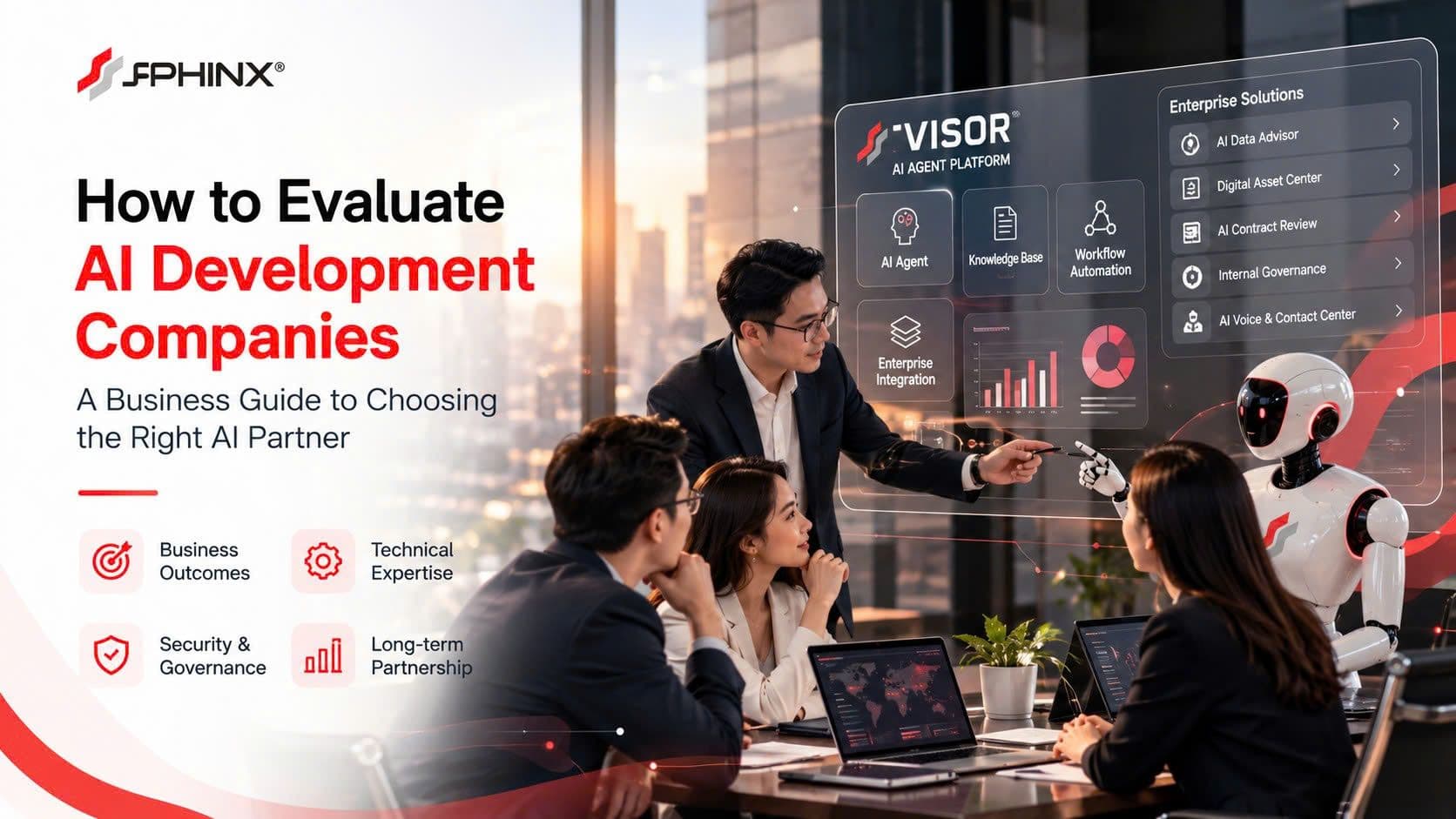
How to Evaluate AI Development Companies: A Business Guide to Choosing the Right AI Partner
Artificial intelligence is transforming how businesses serve customers, process information, and manage operations. From intelligent chatbots to autonomous AI agents, organizations are exploring new ways to improve productivity, reduce repetitive work, and make better decisions.
However, successful AI adoption requires more than choosing a powerful model or hiring a team that can build an application. Businesses need a technology partner that understands their objectives, works with their existing systems, protects sensitive information, and delivers measurable business value.
With numerous AI development companies offering seemingly similar services, how can you identify the right partner?
This guide explains the essential criteria for evaluating an AI development company, the questions to ask before signing a contract, and how to determine whether an AI solution is ready for real-world business use.
1. Start with Business Outcomes, Not AI Technology
One of the most common mistakes businesses make is starting an AI project without clearly defining the problem they want to solve.
A provider may demonstrate an impressive generative AI chatbot or an advanced automation workflow, but technical sophistication alone does not guarantee business value.
Before evaluating potential AI development partners, identify the operational challenge and establish measurable objectives.
For example, your organization may want to:
- Reduce the time employees spend searching internal documents.
- Automate repetitive customer service interactions.
- Improve contract review and document processing.
- Connect fragmented business data to support management decisions.
- Automate multi-step workflows across departments.
- Deliver faster, more consistent customer experiences.
Translate these objectives into measurable key performance indicators (KPIs), such as processing time, error rates, cost per transaction, first-contact resolution, or employee productivity.
A qualified AI development company should help you refine these objectives, assess feasibility, and prioritize use cases according to expected value, implementation complexity, and risk.
What to ask: How will you measure the success of our AI project, and what baseline metrics should we establish before development begins?
2. Evaluate Technical Expertise and AI Development Capabilities
AI development encompasses multiple technologies, and different business problems require different approaches. A capable partner should recommend an architecture based on your requirements rather than force every project into the same technical solution.
Generative AI and enterprise chatbots
Generative AI can help employees and customers interact with information through natural language. Enterprise chatbots can answer questions, summarize documents, retrieve information, and support service workflows.
For internal knowledge assistants, retrieval-augmented generation (RAG) can connect a language model to approved business documents and other knowledge sources. However, retrieval quality, source freshness, access permissions, and evaluation remain essential to producing reliable answers.
AI agent development
AI agents go beyond answering questions. Depending on their configuration and permissions, they can interpret a request, plan a sequence of steps, use approved tools, retrieve information from connected systems, and execute defined actions.
For example, an enterprise AI agent might retrieve customer information, analyze a service request, prepare a response, and route the case to the appropriate team.
More complex processes may require multiple specialized agents coordinated through a shared workflow.
When evaluating an AI agent development company, examine how it handles tool permissions, failed actions, conflicting information, human approvals, and execution logs. The ability to demonstrate a successful task is important, but the ability to manage exceptions is equally critical.
Data analytics and intelligent automation
AI can also support document digitization, data extraction, natural-language reporting, and workflow automation. These applications often require integration with databases, ERP platforms, CRM systems, document repositories, and existing business applications.
The right partner should understand how these components work together, not simply how to develop an AI interface.
What to ask: Can you demonstrate a solution addressing a business problem similar to ours, including its integrations, limitations, and approach to handling errors?
3. Look for Industry Knowledge and Business Process Understanding
AI solutions are most effective when they reflect the way an organization actually operates.
A financial services company, a manufacturer, and a hospitality business may all need AI automation, but their data structures, workflows, compliance requirements, and success criteria differ significantly.
An experienced AI partner should invest time in understanding your operational environment before proposing a solution.
This discovery process should cover:
- Existing workflows and operational bottlenecks.
- Data sources, ownership, and quality.
- User roles and departmental responsibilities.
- Business rules and approval requirements.
- Existing software and integration constraints.
- Industry-specific security and compliance obligations.
For example, an AI agent supporting internal financial reporting needs access to approved data, consistent metric definitions, and traceable calculations. An agent supporting customer service may instead prioritize response quality, escalation accuracy, and integration with customer service systems.
A generic chatbot may be suitable for a simple FAQ use case. More complex business processes require a deeper understanding of operational context.
What to ask: How will your team map our business processes and translate our requirements into an AI solution that fits our organization?
4. Prioritize Security, Data Governance, and Deployment Flexibility
Security should be evaluated from the beginning of an AI project, not added after the system has been developed.
Enterprise AI solutions may process confidential documents, customer information, financial records, or proprietary business knowledge. Without appropriate controls, these systems can introduce risks involving unauthorized access, data leakage, inaccurate outputs, or unintended actions.
When evaluating AI development companies, examine their approach to the following areas.
Data access and permissions: Can the solution enforce access rights based on user roles, departments, and approved data sources?
Privacy and data handling: Where is information processed and stored? Are retention policies, data ownership, and third-party model providers clearly documented?
Deployment options: Can the solution operate in a cloud environment or on-premise infrastructure when required by your security and regulatory needs?
Auditability: Can administrators review system activity, trace AI-generated results to their sources where applicable, and investigate unexpected behavior?
Human oversight: Can the organization define which tasks AI may perform independently and which require human confirmation?
Security requirements vary by organization, so providers should explain the controls available, their limitations, and how they will be validated.
Sphinx JSC’s S-Visor AI platform supports enterprise-oriented AI applications with configurable access, knowledge management, and flexible cloud or on-premise deployment options. The appropriate configuration depends on each organization’s infrastructure, use case, and security requirements.
5. Assess Integration Capabilities and Scalability
An AI solution creates limited value if employees must leave their existing systems, manually transfer information, or duplicate work to use it.
Before selecting a provider, assess whether its solutions can integrate with your current technology environment.
Depending on the project, relevant integration capabilities may include:
- ERP and CRM platforms.
- Enterprise databases and data warehouses.
- Document management systems.
- APIs and webhooks.
- Customer service and ticketing applications.
- Internal reporting and workflow tools.
Integration should also account for authentication, data validation, error handling, and monitoring.
Scalability deserves equal attention. A prototype serving a small group may perform differently when hundreds of employees use it or when it processes large volumes of documents and transactions.
Ask the provider to explain its approach to performance testing, capacity planning, model selection, operating costs, and ongoing maintenance.
A good AI development partner designs for the intended workload while avoiding unnecessary architectural complexity.
6. Compare the Total Cost of Ownership, Not Just Development Fees
The initial development quote rarely represents the full cost of operating an AI solution.
A realistic budget should consider:
- Business analysis and solution design.
- Data preparation and knowledge-base development.
- AI model usage and infrastructure.
- Software development and system integration.
- Security testing and quality assurance.
- Deployment, monitoring, and maintenance.
- User training and ongoing optimization.
The cheapest proposal may become expensive if it requires extensive rework, lacks integration capabilities, or produces unreliable results.
Likewise, a more sophisticated architecture is not automatically the best investment.
Compare providers using the expected total cost of ownership and the value the solution is designed to deliver.
A useful starting point is to estimate the cost per successful task rather than focusing exclusively on the number of AI requests processed. This helps connect technology spending to actual operational outcomes.
What to ask: What costs should we expect after launch, and how will you help us measure the financial and operational return on investment?
7. Examine the Development Methodology and Delivery Team
AI projects involve uncertainty. Data quality may be lower than expected, user requirements may evolve, and early tests may reveal limitations that require changes to the solution.
A structured delivery methodology helps manage these challenges.
A reliable AI development partner should typically provide:
- Discovery and feasibility assessment: Define the problem, target users, available data, constraints, and expected outcomes.
- Solution architecture: Select the appropriate models, integration approach, security controls, and deployment environment.
- Proof of concept: Test the highest-risk assumptions using representative tasks and data.
- Evaluation and validation: Measure accuracy, reliability, latency, cost, and access-control behavior.
- Production implementation: Integrate the solution into business workflows and prepare it for real users.
- Monitoring and improvement: Track performance, resolve issues, update knowledge sources, and refine the system.
Ask who will be responsible for each stage, how progress will be reported, and what documentation will be provided.
You should also understand the team’s expertise across AI engineering, software development, data engineering, security, testing, and project management.
A proof of concept should have clear acceptance criteria and a defined path toward production. A successful demo alone is not sufficient evidence of readiness.
8. Evaluate Business Results and Long-Term Partnership Potential
The relationship with an AI development company should not end when the software is delivered.
AI systems require monitoring, maintenance, evaluation, and adaptation as business processes, data, and user needs change.
Before committing to a provider, establish how performance will be measured after launch.
Relevant KPIs may include:
- Reduction in manual processing time.
- Improvement in task completion and answer quality.
- Decrease in avoidable errors and rework.
- Faster response and resolution times.
- Employee adoption and user satisfaction.
- Cost per completed task.
- Frequency of escalations and operational incidents.
Agree on a baseline, a measurement period, and realistic targets. Where possible, compare results against the existing process rather than relying on subjective impressions.
Also clarify support arrangements, ownership of custom-developed components, documentation, knowledge transfer, and future enhancement costs.
The right partner should be willing to discuss limitations transparently and help your organization build the internal capability to operate the solution sustainably.
Why Consider Sphinx JSC for Enterprise AI Development?
Sphinx JSC is a technology company headquartered in Vietnam, with international operations and experience across enterprise software, SAP, ERP and CRM solutions, custom software development, and AI.
Its AI capabilities include the S-Visor AI Agentic Platform and a broader ecosystem of voice AI and intelligent automation solutions.
S-Visor: AI agents designed around enterprise workflows
S-Visor uses a multi-agent approach to analyze requests, select appropriate agents, coordinate processing, and combine results. Its platform capabilities include knowledge-base management, agent configuration, user permissions, and connections to enterprise data and systems.
This approach is relevant to organizations seeking to move beyond standalone chatbots toward AI-assisted business processes.
Depending on the use case, S-Visor’s solution ecosystem supports applications such as:
- AI Data Advisor: Ask questions about approved business data and generate reports to support decision-making.
- Digital Asset Center: Extract, classify, and retrieve information from business documents.
- AI Contract Review: Support contract analysis and the identification of potential issues.
- Internal Governance: Help organizations review information and identify potential control concerns.
- AI Voice and Contact Center: Support customer interactions, call workflows, and service automation.
These capabilities can be explored individually or as part of a broader enterprise AI initiative. Actual functionality, integrations, and outcomes should be validated against the organization’s requirements.
Flexible deployment and system integration
Sphinx’s AI ecosystem supports cloud and on-premise deployment approaches, with integration options that include databases, APIs, webhooks, and ERP or CRM systems.
This flexibility helps organizations evaluate an implementation strategy that reflects their security requirements, infrastructure, and expected scale.
A practical, business-first approach
Rather than starting with the most complex AI architecture, businesses can begin by identifying a high-value workflow, assessing data readiness, defining measurable KPIs, and testing a focused proof of concept.
This creates a more informed basis for deciding whether to expand the solution across additional teams and processes.
Final Checklist: Choosing the Right AI Development Company
Before making your decision, confirm that your prospective partner can:
- Demonstrate relevant AI and software engineering expertise.
- Understand your business processes and industry requirements.
- Define measurable objectives and a realistic implementation plan.
- Explain data security, access controls, and deployment options.
- Integrate with your existing enterprise systems.
- Evaluate AI quality using representative tasks and clear criteria.
- Provide transparent pricing and a total cost of ownership estimate.
- Support production deployment, monitoring, and continuous improvement.
The best AI development company is not necessarily the one offering the most advanced technology or the lowest price. It is the partner that can translate your business objectives into a secure, maintainable, and measurable solution.
Ready to explore AI agents for your business?
Sphinx JSC can help you assess potential use cases, identify integration requirements, and define a practical starting point for enterprise AI adoption.
Contact the Sphinx team at contact@sphinxjsc.com to discuss your business challenges, explore S-Visor’s capabilities, and evaluate the next steps toward an AI solution tailored to your organization.
Explore Sphinx’s AI capabilities at https://sphinxjsc.com/ or learn more about S-Visor at https://svisor.vn/.