AI Solution Provider in Vietnam: Inside the Sphinx Voice AI and AI Agent Ecosystem

The right AI development company in Vietnam has to do three things well: understand Vietnamese, in speech as well as text; plug into the systems a business already runs, such as ERP, CRM and the contact center; and deploy in a way that meets data-security requirements. Sphinx JSC covers all three with one ecosystem: Voice AI, the S-visor AI agent platform and six packaged enterprise solutions.
AI is no longer an experiment. McKinsey’s “The state of AI” report, published in August 2026, found that nearly nine in ten organizations surveyed use AI in at least one function, yet only 44% have scaled it across the enterprise. In Vietnam, PwC’s Hopes and Fears 2025 survey found that 38% of workers use generative AI every day, more than double the global average of 14%.
The gap between employees using AI and AI running inside business processes is where an AI development company earns its place. This article explains how Sphinx closes that gap.
When does a business need an AI development company instead of off-the-shelf tools?
Off-the-shelf chatbots and AI apps handle personal productivity well. It is time to look for an AI development partner when:
- Data cannot leave your own infrastructure. This is common in government, banking and insurance.
- The input is spoken Vietnamese. Think contact-center calls, meeting recordings, regional accents and sentences that mix Vietnamese and English.
- AI must read from and write to core systems such as CRM, ERP, PMS or Helpdesk, not just answer questions.
- Workflows span several steps and departments, for example lookup, reconciliation, approval and payment.
- You need control and auditability, including role-based access, cited sources and a trail for post-audit.
Who is Sphinx in Vietnam’s enterprise AI landscape?
Sphinx JSC is a technology company headquartered in Hanoi, with operations in South Korea and Australia. It has more than 150 specialists and more than 200 delivered projects. Its work centers on two core capabilities: Voice AI and an AI Agentic Platform. Clients span government and state-owned enterprises, banking and insurance, real estate and tourism, services, manufacturing and technology.
Sphinx works across infrastructure and model providers including AWS, Google Cloud, Microsoft Azure, SAP, Odoo, PostgreSQL, LangChain, OpenAI and Google Gemini. Each deployment is designed around the client’s existing stack and budget, without vendor lock-in.
Two core capabilities: Voice AI and the S-visor AI Agentic Platform
Voice AI: modeled on how people listen, understand and speak
Sphinx Voice AI combines five capabilities. The figures below are from Sphinx’s internal testing.
- Listen (Speech-to-Text): trained on 15,000 hours of audio. It reaches a Vietnamese error rate of around 5.1% and a response time of around 300 ms, and stays stable on weak connections with noise reduction.
- Understand (SSAP): acoustic and linguistic analysis that detects emotion, stress level, regional accent and speaking rate.
- Speak (Text-to-Speech): natural-sounding voices with code-switching, so Vietnamese and English can be mixed within the same sentence.
- Verify (Speaker Verification): identifies each person’s voiceprint, with an equal error rate (EER) of 0.317% on a test set of 50 million voice pairs.
- Protect (Anti-Spoofing): detects voice deepfakes, voice conversion and replay attacks in under 50 ms, with a FAR of 0.01% and an FRR of 0.35%.
S-visor AI Agentic Platform: turning data into operational capability
S-visor is a multi-agent platform. When a request arrives, S-visor analyzes it, selects the right agents (for example information lookup, claims support, HR or payments), orchestrates the workflow and consolidates the result. Unlike a question-and-answer chatbot, it automates chains of actions across several steps. Administrators manage data repositories, agent configuration and user permissions from one console.
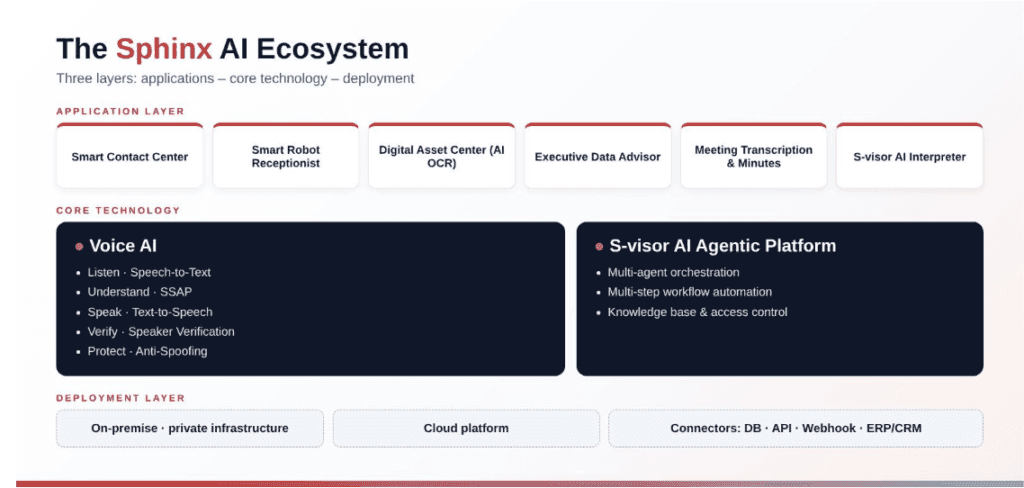
The Sphinx AI ecosystem: six applications running on two core technologies and two deployment options.
Six AI solutions in the Sphinx ecosystem
1. Smart Contact Center: an AI agent that never sleeps
For inbound calls, AI answers 24/7 with around one second of latency and handles price inquiries, bookings and order lookups from standard scripts. For outbound calls, AI places reminder and sales calls, then qualifies interested leads and hands them to the sales team. Call data syncs to CRM or PMS once each call ends. The system also automatically scores how closely agents follow the script.
2. Smart Robot Receptionist
VIPI and MIA robots work in office lobbies, hotels, public-service centers and exhibitions. Using AI cameras, they recognize VIP guests and greet them by name. They also give directions, answer service questions and issue queue numbers through natural voice conversation.
3. Digital Asset Center (AI OCR)
Digital Asset Center reads invoices, contracts, blurry scans and even handwriting. It goes beyond recognizing characters to understanding the content. It extracts fields such as contract number, value, signing date and counterparty, scores the confidence of each field and flags any that need human review. Results export to Excel, Word, JSON or an API and are stored in a permission-controlled knowledge base.
4. Executive Data Advisor
Executives ask questions in plain Vietnamese, typed or spoken, for example “How is business line A performing this month, and which costs are over budget?” The AI searches ERP, CRM, documents and databases and answers with cited sources. It can also run what-if scenarios such as “What happens to profit if we cut prices by 10%?”
5. Meeting Transcription and Minutes
Users upload MP3, WAV or MP4 files, or record live in the meeting room. The AI separates each speaker, adds timestamps and summarizes key decisions, action items and deadlines. It then exports formatted minutes to Word or PDF. Clicking a keyword jumps to the matching audio segment, and a fake-voice filter helps protect the legal integrity of the record.
6. S-visor AI Interpreter: real-time interpretation
The AI listens, translates and speaks in three languages with 2–4 seconds of latency. Output appears on LED screens and on attendees’ phones via a QR code, with no limit on the number of listeners. It learns industry terminology from event slides and brochures and generates multilingual records after the conference.
Sphinx built Neotels, an AI concierge for the hospitality industry, on the same foundation. Neotels shows how the ecosystem can be packaged into vertical products (read more).
On-premise or cloud deployment?
- On-premise: the entire system runs on the organization’s own infrastructure, which maximizes privacy and compliance. This option suits government agencies, banks and state-owned enterprises.
- Cloud: lower upfront investment (CAPEX) and elastic scaling as users grow. This option suits growth-stage businesses.
Both options connect through databases, APIs, webhooks and ERP/CRM systems, with organization-level access control over the knowledge base. The choice matters more in Vietnam now. The Personal Data Protection Law (91/2025/QH15) took effect on 1 January 2026, and the Law on Artificial Intelligence took effect on 1 March 2026. The AI law classifies AI systems by risk level and requires human oversight of important decisions.
A five-step engagement process
- Discovery: define the process to automate and the success metrics.
- Data and infrastructure assessment: review data sources, the systems to integrate and security requirements.
- Demo and proof of concept: run a small-scope trial on your own real data.
- Integration and deployment: connect CRM, ERP and telephony, then deploy on-premise or in the cloud.
- Operate and optimize: monitor quality, refine scripts and expand to other departments.
How to choose an AI development company in Vietnam
- Proven products in production, not just claims of what could be built.
- Strong Vietnamese handling, including regional accents, call-center noise and mixed-language speech.
- Integration with your existing systems rather than requiring replacements.
- A real on-premise option and a clear security process.
- Published, measurable benchmarks and willingness to test on your data.
- Local post-deployment support in Vietnam.
Frequently asked questions
What AI solutions does Sphinx offer?
Sphinx offers Voice AI (speech recognition, speech synthesis, speaker verification and anti-spoofing), the S-visor AI agent platform and six solutions: Smart Contact Center, Smart Robot Receptionist, Digital Asset Center, Executive Data Advisor, Meeting Transcription and S-visor AI Interpreter.
Can Sphinx solutions be deployed on-premise?
Yes. The ecosystem can be deployed entirely on an organization’s own infrastructure for teams whose data must stay inside internal systems.
Does Sphinx Voice AI understand regional Vietnamese accents?
The recognition models are optimized for regional accents, industry terms and unstable signals. We recommend running a proof of concept on your own call data to evaluate performance.
Can it integrate with our existing CRM or ERP?
Yes. Data syncs through APIs, webhooks and databases, or through direct connections to ERP, CRM and Helpdesk systems.
What drives the cost of an AI deployment?
Cost depends on the number of solutions, the volume of calls or documents, the depth of integration and the deployment model. Sphinx provides a quote after the discovery session.
Conclusion
Choosing an AI development company in Vietnam is about more than hiring developers. You are choosing a partner that understands Vietnamese, your processes and your data-compliance obligations. With Voice AI, the S-visor platform and six ready-to-deploy solutions, Sphinx helps businesses move from experimenting with AI to running on it.
Ready to put AI to work?