AI Development Cost in 2026: What Drives the Price and How to Budget

Introduction
AI is moving from experimentation into everyday business operations. Companies are exploring AI assistants, document automation, predictive analytics, voice AI, and AI agents that can coordinate multi-step workflows. But before approving an initiative, decision-makers need to answer a practical question: how much will AI development cost in 2026?
There is no universal price tag. A small AI feature connected to an existing application is fundamentally different from an enterprise platform that combines private data, multiple systems, complex permissions, high availability, and ongoing monitoring. Even two projects that look similar in a demo may have very different costs once data quality, security, integration, and real-world usage are considered.
The most useful way to budget is to look beyond the initial build. This guide explains the main cost drivers, the expenses teams often overlook, how to estimate total cost of ownership, and how to start with a manageable scope without losing sight of business value.
How Much Does AI Development Cost in 2026?
AI project budgets vary by scope, delivery model, geography, technology choices, data readiness, and risk. Public industry estimates can help with early planning, but they are not comparable unless they describe the same scope and assumptions. A quoted figure may include only a prototype- or it may include production integrations, security testing, deployment, support, and post-launch improvements.
Use the following categories to frame an initial discussion, not as a vendor price list:
- Proof of concept (PoC): Tests whether a narrowly defined use case is technically feasible and valuable. It should use a small set of representative data and limited integrations.
- Minimum viable product (MVP): Delivers a usable version for a defined workflow or user group, with basic operational controls and selected integrations.
- Department-level solution: Supports a business function with production data, permissions, workflow integration, monitoring, user onboarding, and support.
- Enterprise platform: Serves multiple teams or use cases and may require stronger governance, identity controls, resilience, integration standards, and cost management.
- Advanced custom AI: May involve custom model development, specialized hardware, high-volume inference, multimodal processing, or demanding regulatory and performance requirements.
Rather than relying on a generic range, ask vendors to state the assumptions behind their estimate: features included, systems connected, data preparation required, quality targets, deployment environment, usage volumes, support period, and exclusions. That is the only way to compare proposals fairly.
The 8 Main Factors That Drive AI Development Cost
- Business scope and workflow complexity
A chatbot answering approved FAQs is not the same as an AI agent that searches records, makes decisions, updates a CRM, and escalates exceptions. Every additional workflow, user role, exception path, and business rule increases design, engineering, testing, and maintenance effort. Begin by asking whether a conventional rule or existing software feature could solve the problem more simply. - Data quality and preparation
AI depends on the data it can access. Information may be duplicated, outdated, scattered across file shares, stored in incompatible formats, or missing ownership and permissions. Teams may need to clean, classify, label, redact, normalize, or index data before it is useful. In document AI, scan quality and document variation also affect extraction accuracy. Data readiness can therefore be a major budget variable, even when the AI model itself is available through an API. - Model and architecture choices
A solution might use a hosted model API, retrieval-augmented generation (RAG), a fine-tuned model, a traditional machine-learning model, or a combination. RAG can connect a language model to approved enterprise knowledge; fine-tuning may be useful for certain repeatable behavior or domain tasks; custom model training is a different and usually more demanding undertaking. The best choice depends on accuracy, latency, privacy, data availability, and workload- not on which approach sounds most advanced. - Integration with existing systems
Production AI often needs to connect to ERP, CRM, ticketing, document management, databases, contact-center platforms, or internal APIs. Integration effort depends on API maturity, data consistency, legacy constraints, authentication, write permissions, error handling, and testing environments. A prototype that works in isolation may need substantial additional work before it can safely operate inside a business process. - Security, privacy, and compliance
Cost rises when a use case handles sensitive data, serves regulated operations, or requires detailed auditability. Common work includes identity and access management, role-based permissions, encryption, retention rules, data residency assessment, logging, vulnerability testing, human review, and documentation. These controls should be scoped early; adding them after a pilot can create rework. - Infrastructure and deployment model
Cloud services can reduce the need to buy and operate hardware, while on-premise or dedicated deployments may be appropriate for specific security, residency, latency, or infrastructure requirements. Costs can include compute, storage, networking, vector databases, observability, backup, and environments for development, testing, and production. The right option depends on workload and operating constraints rather than a simple cloud-versus-on-premise rule. - AI usage and inference
The bill continues after launch. Model usage may be priced by tokens, requests, images, audio, compute time, or provisioned capacity, depending on the service. Total spend depends on the number of users, requests per user, prompt and context size, response length, model choice, retries, and agent steps. Multi-agent workflows can make several model or tool calls for a single user request, so usage assumptions should reflect the complete workflow rather than just the first response. - Talent, testing, and lifecycle support
AI projects require product ownership, software engineering, data engineering, AI expertise, security input, QA, and subject-matter review. Evaluation is especially important because plausible language is not proof of correctness. Teams need representative test cases, edge-case testing, monitoring, feedback handling, model or prompt updates, and periodic reassessment as business data changes.
The Hidden Costs Many Budgets Miss
The initial development quote is only one component of the investment. A realistic budget should consider:
- Discovery and process analysis: workshops, workflow mapping, requirements, and success criteria.
- Data readiness: source audits, cleanup, permissions, document processing, and knowledge-base preparation.
- Evaluation and human review: building test sets, expert validation, and review of high-risk outputs.
- Integration and change management: adapting existing systems, training users, updating procedures, and communicating limitations.
- Production operations: hosting, model consumption, logging, monitoring, backups, support, and incident response.
- Governance: security reviews, access audits, policy updates, and evidence for compliance.
- Iteration: improving retrieval, prompts, workflows, model routing, and user experience after observing real usage.
These costs do not apply equally to every project. Their purpose is to prevent a misleading comparison between a bare prototype and a production-ready system. Ask each vendor to separate one-time implementation costs from recurring operational costs and optional future enhancements.
How to Build a Practical AI Budget
Step 1: Define a measurable business outcome
Avoid a broad goal such as “implement AI across the company.” Choose a problem such as reducing time spent searching for policies, improving first-line support, or accelerating extraction of defined fields from documents. Record the current baseline.
Step 2: Set boundaries for the first release
Specify users, workflows, data sources, integrations, supported languages, volume assumptions, and actions the AI may take. Explicitly list what is out of scope. A focused first release is easier to estimate and evaluate.
Step 3: Estimate build and run costs separately
Build costs may include discovery, design, data preparation, development, integration, testing, security review, and deployment. Run costs may include model usage, cloud infrastructure, monitoring, support, maintenance, and ongoing evaluation. Use low, expected, and high scenarios for variable consumption.
Step 4: Model usage rather than guessing
Estimate monthly users, requests per user, average input and output size, retrieval activity, tool calls, and peak traffic. Apply current provider pricing to these assumptions and include a buffer for retries and growth. Check official pricing pages before approval because models, regions, and pricing tiers change.
Step 5: Include risk and contingency
Record assumptions that could change cost: unknown data quality, undocumented legacy systems, accuracy thresholds, compliance requirements, and adoption. For uncertain AI behavior, use a discovery or PoC phase before locking the full scope into a fixed price.
Step 6: Define acceptance criteria
Agree on how success will be tested: correctness, source grounding, task completion, response time, permission enforcement, availability, and cost per successful outcome. Clear acceptance criteria reduce disputes and prevent “it looks good in a demo” from becoming the only definition of done.
Step 7: Review the business case
Estimate benefits conservatively. Potential value may include time saved, lower rework, faster response, improved service availability, or increased capacity. Do not treat all time saved as cash savings unless the organization can actually redeploy that capacity or reduce expenditure. Compare expected value with the full cost of ownership.
A Simple Total Cost of Ownership Model
Use a three-year view where practical. A simplified model is:
Total cost of ownership = initial implementation + data and integration work + recurring AI usage + infrastructure + support and maintenance + governance and evaluation + planned enhancements.
Then compare it with measurable outcomes over the same period. For example, if an internal knowledge assistant saves employees time, estimate the number of eligible requests, the average time saved per request, the proportion of answers that require follow-up, and adoption levels. If an AI contact-center solution supports calls, evaluate resolution quality, escalation rates, handling time, and customer experience- not just the number of calls processed.
Run sensitivity scenarios. What happens if usage doubles? If model prices change? If a human must review more outputs than expected? If adoption is lower than planned? Scenario planning makes uncertainty visible and helps leaders decide whether to narrow, expand, or stop the initiative.
Ways to Control Cost Without Sacrificing Quality
Start small and scale based on evidence. A focused pilot limits initial exposure and helps teams learn which requirements actually matter.
Use the simplest suitable architecture. Not every workflow needs fine-tuning, custom model training, or autonomous agents. Rules, search, a hosted model, or a hybrid approach may be sufficient.
Match model capability to task. Use more capable models where reasoning quality warrants the cost, and evaluate lower-cost models for routine classification, extraction, or summarization. Model routing should be validated against quality and latency requirements.
Reduce unnecessary context. Keep prompts focused, retrieve relevant passages instead of sending entire document collections, limit output length where appropriate, and avoid redundant calls. Caching or batch processing may help for suitable workloads.
Instrument usage from day one. Track cost by application, workflow, team, and outcome where possible. Set budgets and alerts, monitor unusual consumption, and review expensive or low-value interactions.
Keep humans in the loop where the risk demands it. The objective is not maximum automation at any cost; it is a reliable workflow that balances speed, quality, control, and economics.
Questions to Ask an AI Development Partner
Before selecting a partner, ask:
- What exactly is included in the estimate, and what is excluded?
- Which assumptions about data, usage, accuracy, and integration drive the price?
- What will the PoC prove, and what criteria determine whether to proceed?
- How will sensitive information and user permissions be handled?
- How will the team test hallucinations, failures, and unauthorized actions?
- Which costs recur after launch, and how will usage be monitored?
- Who owns the source code, prompts, data pipelines, and documentation?
- How will the solution be maintained as models, APIs, and business requirements change?
A good proposal should explain trade-offs, risks, and options- not simply promise a low price or a fast delivery date.
How Sphinx Can Help You Plan AI Investment
Sphinx JSC works across Voice AI and the S-Visor AI Agentic Platform, with solutions that can be scoped to business needs rather than forcing every organization into the same architecture.
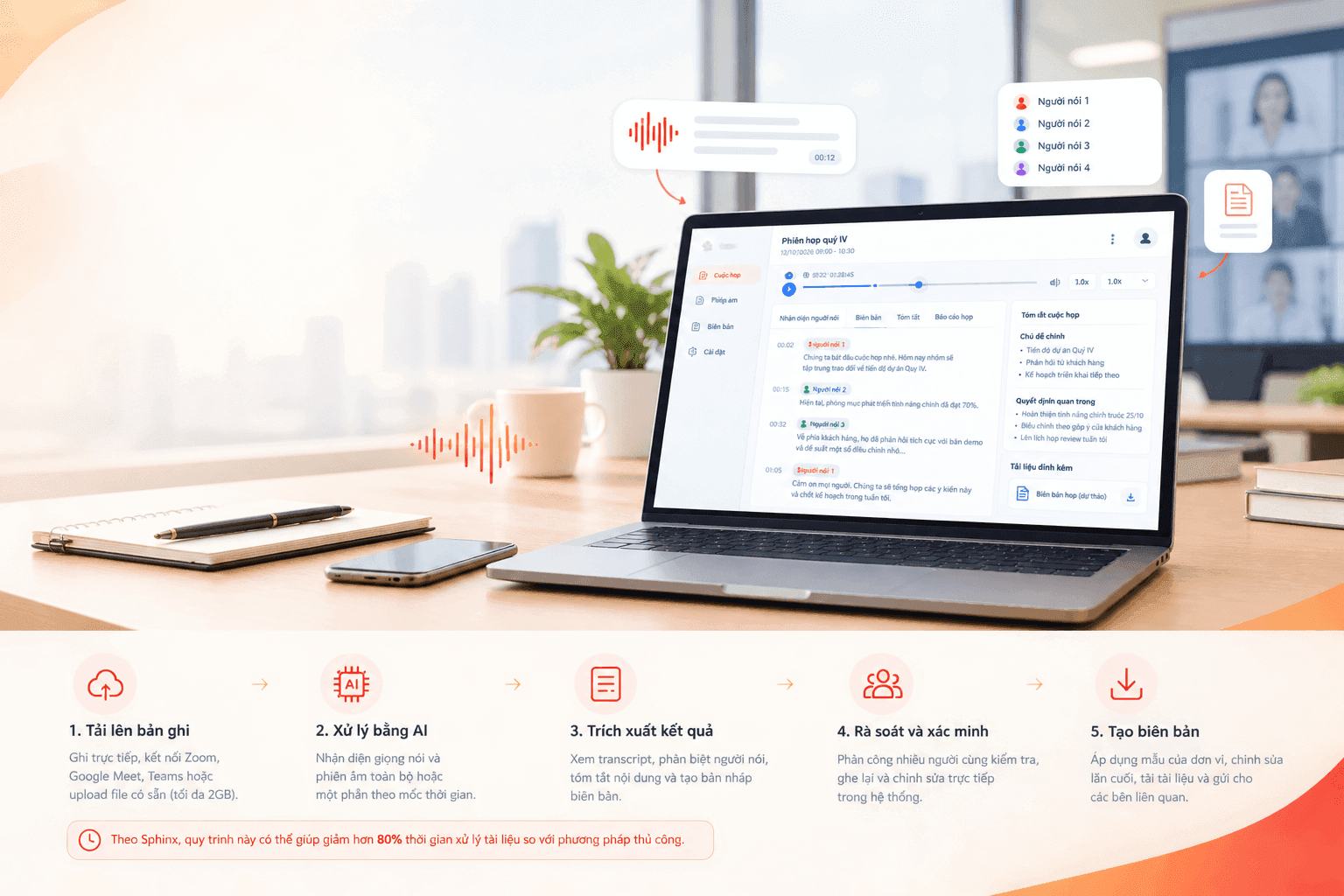
Depending on the use case, Sphinx’s AI ecosystem includes S-Visor for agent orchestration and enterprise knowledge workflows; Smart Contact Center for AI-assisted calling; Meeting Transcription and Reporting; Digital Asset Center for OCR and document extraction; Executive Data Advisor for natural-language questions over approved business data; and S-Visor AI Interpreter for multilingual communication. Deployment options described in Sphinx’s materials include cloud and on-premise approaches, with integration possibilities through databases, APIs, webhooks, and ERP/CRM systems.
The best starting point is a discovery conversation: identify the business problem, map the data and integrations, agree on success metrics, and estimate both implementation and operating costs. From there, a focused proof of concept can test feasibility and value before a wider commitment.
In 2026, the most useful AI budget is not the one with the lowest initial quote. It is the one that makes assumptions explicit, accounts for the cost of operating the solution, and ties investment to a business outcome that can be measured. Start with the problem, estimate the whole lifecycle, and scale when the evidence supports it.