



Automation today is no longer limited to executing predefined rules. As businesses operate in increasingly complex and data-rich environments, there is a growing need for systems that can make decisions, adapt to change, and continuously improve over time. Traditional automation alone cannot meet these demands, especially when dealing with unstructured data, dynamic workflows, and real-time decision-making.
Machine learning addresses this gap by enabling automation systems to learn from data and evolve. Instead of relying solely on static logic, these systems can identify patterns, predict outcomes, and optimize actions based on both historical and real-time inputs. This shift transforms automation from a task executor into an intelligent, adaptive capability that supports more informed and responsive operations.
In this blog, we explore the fundamentals of machine learning in AI automation, how it works within modern systems, and why it is becoming essential for scalable, intelligent operations. We also examine key approaches, common misconceptions, implementation challenges, and its strategic role in shaping next-generation automation.
What Is Machine Learning in AI Automation?
Machine Learning in AI Automation refers to the integration of data-driven learning algorithms into automated systems, enabling them to continuously improve performance without explicit reprogramming. Instead of relying on static rules, these systems learn from historical data, user behavior, and real-time inputs to make increasingly accurate decisions over time.
At its core, this convergence transforms automation from a rigid execution tool into a dynamic, self-improving capability. It allows organizations to move beyond predefined workflows and toward systems that can interpret patterns, anticipate outcomes, and adjust actions autonomously.
자세히 보기 AI Automation: How It Works, Benefits, and Best Practices
Difference Between AI, Machine Learning, and Automation
| Criteria | Artificial Intelligence (AI) | Machine Learning (ML) | Automation |
|---|---|---|---|
| Definition | Broad field focused on building systems that simulate human intelligence | Subset of AI that enables systems to learn from data and improve over time | Technology used to perform tasks with minimal human intervention |
| Core Function | Reasoning, decision-making, perception, language understanding | Pattern recognition, prediction, and data-driven learning | Task execution based on predefined rules or logic |
| Learning Capability | May include learning (through ML) but not always required | Learns continuously from data and experience | Does not learn; operates on fixed instructions |
| Flexibility | High, can adapt to complex and dynamic scenarios | High, improves performance as more data is available | Low, limited to predefined scenarios |
| Data Dependency | Often requires data for intelligent behavior | Strongly dependent on large volumes of data | Minimal data dependency |
| Example Use Cases | Chatbots, computer vision, recommendation systems | Fraud detection, demand forecasting, personalization | Workflow automation, data entry, rule-based processes |
| Role in Systems | Acts as the overarching intelligence layer | Serves as the learning engine within AI | Executes tasks within a process or workflow |
Although closely related, AI, Machine Learning, and Automation play different roles within intelligent systems. AI is the broader concept focused on enabling machines to simulate human intelligence, including reasoning and decision-making. Machine Learning is a subset of AI that allows systems to learn from data and improve over time. Automation, in contrast, is responsible for executing tasks based on predefined rules or instructions.
In simple terms, automation handles execution, machine learning enables systems to learn, and AI brings intelligence into decision-making. Together, they form the foundation of modern intelligent automation, where systems not only perform tasks but also continuously improve how those tasks are carried out.
Why Machine Learning Is Critical for Modern Automation
Modern automation is no longer just about efficiency. To operate effectively in dynamic, data-heavy environments, automation systems must be able to adapt, learn, and make decisions. Machine learning provides these capabilities, making it a core component of next-generation automation.
Handling complex and unstructured data
Traditional automation works well with structured, rule-based inputs, but struggles with unstructured data such as text, images, or user behavior. Machine learning enables systems to process and extract meaning from these data types, allowing automation to operate in more complex, real-world scenarios.
Enabling data-driven decision-making
Instead of relying on fixed rules, machine learning allows automation systems to make decisions based on patterns and insights derived from data. This leads to more accurate outcomes, especially in areas like customer segmentation, risk assessment, and demand forecasting.
Adapting to changing conditions
Business environments are constantly evolving. Machine learning allows automation systems to adjust their behavior based on new data, reducing the need for manual updates and ensuring that processes remain relevant over time.
Improving performance through continuous learning
One of the key advantages of machine learning is its ability to improve over time. As more data is collected, models become more accurate, enabling automation systems to optimize workflows, reduce errors, and enhance efficiency continuously.
Supporting personalization at scale
Machine learning enables automation systems to tailor outputs based on individual user behavior and preferences. This is particularly valuable in areas such as marketing, customer experience, and product recommendations, where personalization drives engagement and conversion.
Reducing reliance on manual rule-setting
Rule-based automation requires constant human intervention to define and update logic. Machine learning reduces this dependency by allowing systems to learn patterns automatically, saving time and increasing scalability.
How Machine Learning Powers Adaptive AI Automation Systems
At the core of adaptive AI automation is a continuous loop that allows systems to operate intelligently in dynamic environments. This loop can be simplified into four key stages: Sense → Think → Act → Learn. Together, they form the foundation of systems that not only execute tasks but also evolve over time.
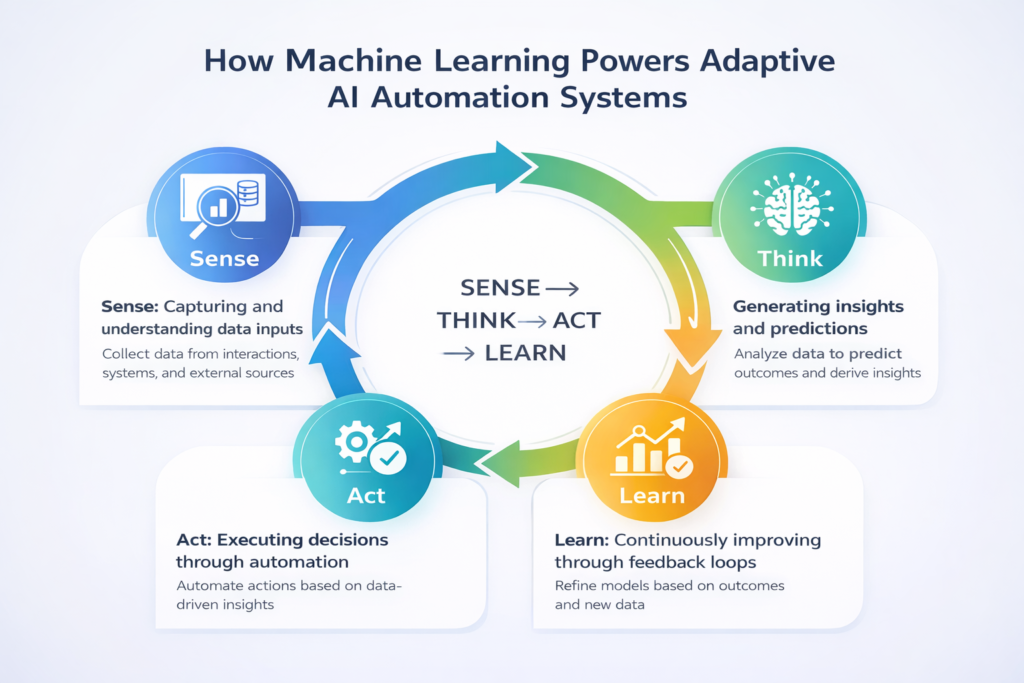
Sense: Capturing and understanding data inputs
The first step is collecting and interpreting data from various sources such as user interactions, enterprise systems, IoT devices, or external platforms. Machine learning enables systems to go beyond structured data by processing unstructured inputs like text, images, or behavioral signals. At this stage, the goal is not just data collection, but extracting meaningful signals that reflect real-world conditions.
Think: Generating insights and predictions
Once data is processed, machine learning models analyze patterns and generate predictions or classifications. This is where the system “thinks” by evaluating possible outcomes and determining the most relevant insight. For example, a model may predict customer churn risk, detect anomalies in transactions, or recommend the next best action. This stage transforms raw data into actionable intelligence.
Act: Executing decisions through automation
Based on the insights generated, the system triggers automated actions within workflows. These actions can range from sending personalized offers and routing support tickets to adjusting supply chain operations or flagging suspicious activities. Unlike traditional automation, decisions at this stage are guided by machine learning outputs rather than fixed rules, making execution more context-aware and dynamic.
Learn: Continuously improving through feedback loops
The final stage closes the loop. As the system operates, it collects new data on outcomes and performance. This feedback is used to retrain and refine machine learning models, improving accuracy and decision quality over time. Continuous learning ensures that the system adapts to changing conditions, user behavior, and business needs without requiring constant manual intervention.
Types of Machine Learning Used in AI Automation
Machine learning in AI automation is not a single approach but a combination of techniques, each designed to solve different types of problems. Choosing the right method depends on the nature of the data, the business objective, and the level of complexity required.
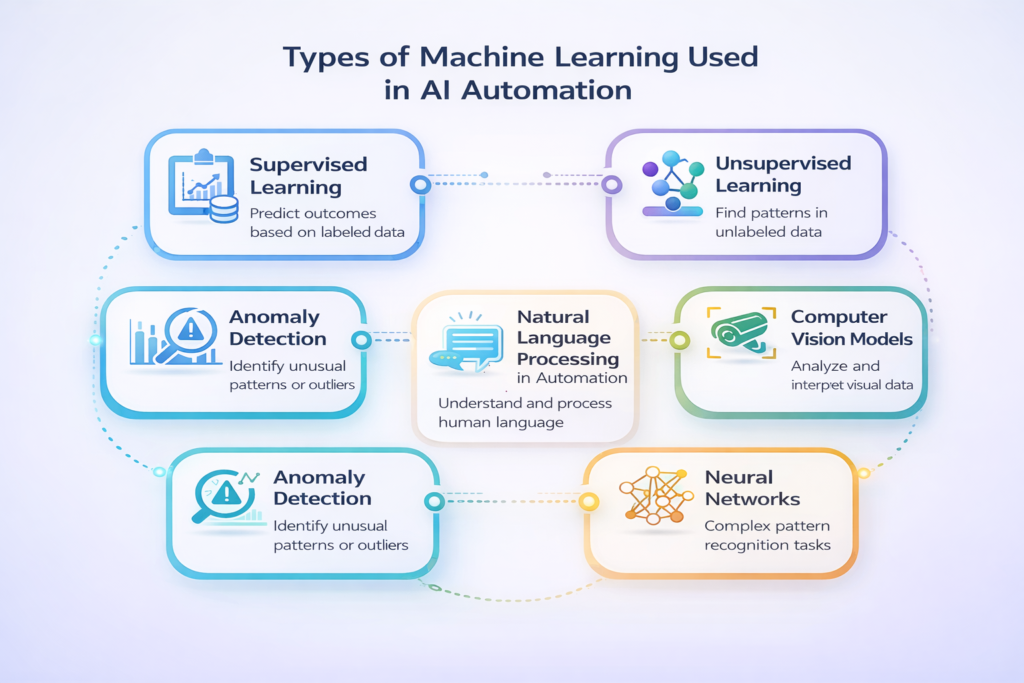
Supervised Learning
Supervised learning is the most commonly used approach in automation. It relies on labeled data to train models that can predict outcomes or classify inputs. This method is highly effective for use cases such as demand forecasting, customer churn prediction, and fraud detection, where historical data with known outcomes is available.
Unsupervised Learning
Unsupervised learning works without labeled data, focusing on discovering hidden patterns or structures within datasets. It is often used for customer segmentation, behavior clustering, and identifying trends that are not immediately visible. This approach is valuable when businesses want to explore data rather than predict predefined outcomes.
Anomaly Detection
Anomaly detection is a specialized form of machine learning used to identify unusual patterns or outliers. In automation, it plays a critical role in areas like fraud detection, system monitoring, and cybersecurity. By continuously scanning data, it helps organizations detect risks and trigger automated responses in real time.
Natural Language Processing in Automation
Natural Language Processing (NLP) enables systems to understand and process human language. In AI automation, NLP powers chatbots, virtual assistants, sentiment analysis, and document processing. It allows automation systems to interact with users, extract meaning from text, and handle unstructured language data efficiently.
자세히 보기 NLP in AI Automation: A Complete Guide
Computer Vision Models
Computer vision allows machines to interpret and analyze visual data such as images and videos. In automation, it is widely used in quality control, facial recognition, object detection, and surveillance systems. This capability is essential for industries like manufacturing, retail, and healthcare, where visual inspection is critical.
Neural Networks for Complex Pattern Recognition
Neural networks, particularly deep learning models, are designed to handle highly complex and high-dimensional data. They are used in advanced scenarios such as speech recognition, recommendation systems, and predictive analytics. These models excel when traditional algorithms cannot capture intricate relationships within data.
What People Get Wrong About Machine Learning in Automation
Despite its rapid adoption, machine learning in automation is often misunderstood. These misconceptions can lead to unrealistic expectations or ineffective implementation strategies.
Machine learning can fully replace humans
A common belief is that machine learning eliminates the need for human involvement. In reality, human expertise remains essential for defining objectives, preparing data, validating outputs, and making strategic decisions. Machine learning augments human capabilities rather than replacing them.
More data always guarantees better results
While data is critical, simply having large volumes of data does not ensure accuracy. Poor-quality, biased, or irrelevant data can lead to misleading outcomes. What matters most is not just quantity, but data quality and relevance.
Machine learning models are “set and forget”
Many assume that once deployed, models will continue to perform effectively without intervention. In practice, models require continuous monitoring, retraining, and optimization to adapt to changing data and business conditions.
Machine learning can solve any automation problem
Not all processes need machine learning. For simple, rule-based tasks, traditional automation is often more efficient and cost-effective. Applying machine learning unnecessarily can increase complexity without delivering proportional value.
Implementation is purely a technical challenge
Organizations often view machine learning adoption as a technology issue. However, success depends equally on business alignment, data strategy, and cross-functional collaboration. Without these, even the most advanced models may fail to deliver impact.
Challenges of Using Machine Learning in AI Automation
While machine learning unlocks powerful capabilities for automation, its implementation is far from straightforward. Organizations must navigate a range of technical and strategic challenges to fully realize its value.
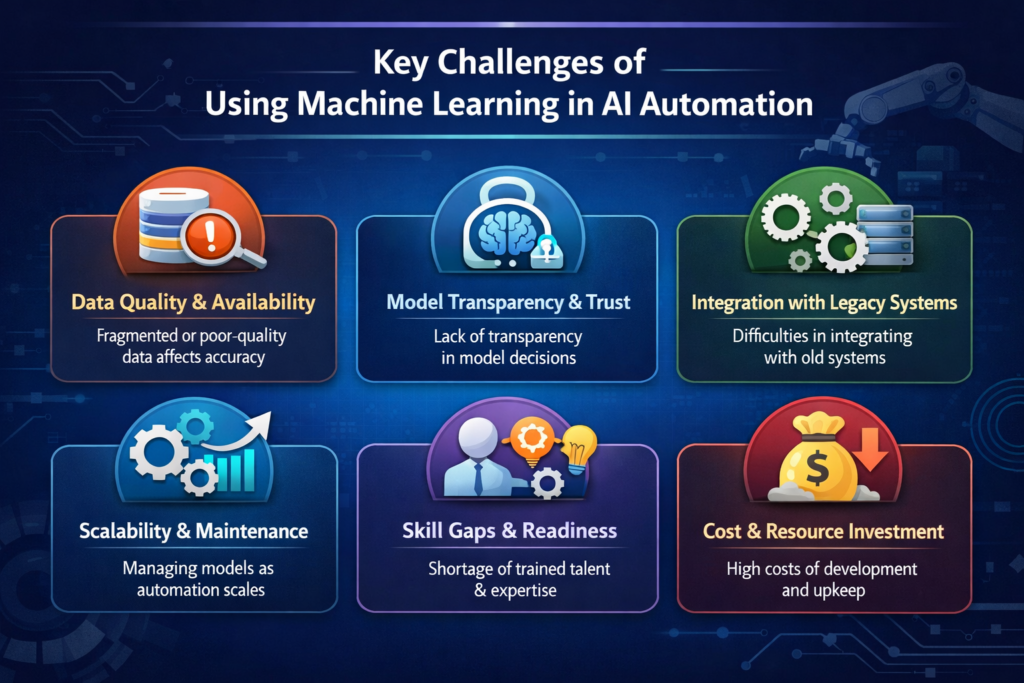
Data quality and availability
Machine learning models rely heavily on data, but in many organizations, data is fragmented, inconsistent, or incomplete. Poor data quality can lead to inaccurate predictions and unreliable automation outcomes. Ensuring clean, well-structured, and relevant data is often the biggest hurdle.
Model transparency and trust
Many machine learning models, especially complex ones like neural networks, operate as “black boxes.” This lack of transparency makes it difficult for stakeholders to understand how decisions are made, which can limit trust and adoption, particularly in regulated industries.
Integration with existing systems
Embedding machine learning into existing automation workflows is not always seamless. Legacy systems, siloed architectures, and incompatible data formats can create significant integration challenges, requiring additional infrastructure and engineering effort.
Scalability and maintenance
Deploying a model is only the beginning. As automation scales across multiple processes, organizations must manage model performance, versioning, and infrastructure. Continuous monitoring and retraining are required to prevent performance degradation over time.
Skill gaps and organizational readiness
Successful implementation requires a combination of data science, engineering, and business expertise. Many organizations lack the necessary talent or cross-functional alignment, making it difficult to operationalize machine learning effectively.
Cost and resource investment
Building, deploying, and maintaining machine learning systems can be resource-intensive. From data infrastructure to model development and ongoing optimization, the investment required may be significant, especially for large-scale deployments.
자세히 보기 Challenges of AI Automation Every Business Should Know
The Strategic Role of Machine Learning in Intelligent Automation
Machine learning plays a foundational role in shaping intelligent automation strategies. It enables organizations to transition from efficiency-driven automation to insight-driven operations.
At a strategic level, machine learning supports three key capabilities.
First, it enhances decision intelligence by providing predictive and prescriptive insights that guide automated actions. This allows businesses to anticipate trends rather than react to them.
Second, it drives operational agility. Systems equipped with machine learning can adapt to changing conditions without requiring constant manual updates.
Third, it unlocks personalization at scale. By analyzing user behavior and preferences, machine learning enables highly tailored experiences across customer journeys.
For organizations investing in AI platforms, machine learning becomes the core engine that connects data, analytics, and automation into a unified ecosystem. It is not merely a feature, but a strategic enabler of adaptive intelligence.
Final Thoughts
Machine Learning in AI Automation is no longer a futuristic concept. It is a practical necessity for organizations aiming to stay competitive in a data-driven world. By enabling systems to learn, adapt, and optimize continuously, machine learning transforms traditional automation into a strategic tool for smarter decision-making and operational agility.
At 스핑크스, we specialize in developing AI-powered solutions that integrate machine learning into automation workflows, helping businesses unlock adaptive intelligence and achieve measurable outcomes. Whether it’s predictive analytics, process optimization, or intelligent decision support, our platform empowers organizations to harness the full potential of AI automation today.



CEO - Son Le
기타 블로그
블로그
AI Chatbot Applications: Benefits, Use Cases, and Future Trends
Artificial Intelligence (AI) is rapidly transforming the way businesses communicate with customers, automate workflows, and deliver personalized experiences. At the center of this transformation is the AI chatbot, an intelligent virtual assistant capable of understanding natural language, answering questions, and supporting users across websites, mobile apps, and messaging platforms. As...
자세히 보기블로그
How AI Is Revolutionizing Hotel Operations and Revenue
The hospitality industry is undergoing one of its biggest transformations in decades. As guest expectations continue to rise and operational costs increase, hotels are turning to Artificial Intelligence (AI) to stay competitive. From maximizing room revenue to delivering personalized guest experiences, AI is no longer a futuristic concept. It has...
자세히 보기블로그
AI Chatbots in Hospitality: Drive Bookings & Better Service
The hospitality industry is rapidly embracing AI as guest expectations continue to evolve. Today’s travelers expect instant responses, personalized recommendations, and seamless communication throughout their booking journey. To meet these demands while improving operational efficiency, more hotels are turning to AI chatbots. Modern AI chatbots do far more than answer...
자세히 보기기타 블로그
서비스
IoT 개발
SphinX는 최첨단 IoT 개발 서비스를 제공하여 디바이스를 원활하게 연결하고 혁신적인 솔루션을 제공합니다.
테마서비스
블록체인 개발
우리는 신뢰할 수 있고 안전한 블록체인 기술을 처음부터 설계하는 데 매우 능숙하며, ...
테마서비스
ERP 및 CRM 개발
필요한 ERP & CRM 개발 서비스! 비즈니스 프로세스 간소화 및 조직 효율성 향상....
테마기타 블로그
서비스
IoT 개발
SphinX는 최첨단 IoT 개발 서비스를 제공하여 디바이스를 원활하게 연결하고 혁신적인 솔루션을 제공합니다.
테마서비스
블록체인 개발
우리는 신뢰할 수 있고 안전한 블록체인 기술을 처음부터 설계하는 데 매우 능숙하며, ...
테마서비스
ERP 및 CRM 개발
필요한 ERP & CRM 개발 서비스! 비즈니스 프로세스 간소화 및 조직 효율성 향상....
테마