



In the rapidly evolving landscape of Industry 4.0, manufacturing enterprises in 2025 face unprecedented pressure to enhance agility, reduce costs, and increase throughput without compromising quality. The pursuit of operational excellence is no longer a competitive advantage, it’s a necessity.
Augmented Reality (AR), once perceived as a futuristic novelty, has emerged as a core enabler of digital transformation on the factory floor. By overlaying digital information onto physical environments in real time, AR empowers workers, engineers, and decision-makers to interact with production systems in ways that were previously unimaginable.
This blog explores how AR is unlocking new levels of efficiency in manufacturing operations in 2025, offering real-world value across training, maintenance, design, and collaboration.
What Is AR in Manufacturing?
Augmented Reality (AR) in manufacturing refers to the use of interactive, real-time digital overlays to enhance the physical production environment. These overlays can include visual instructions, 3D models, sensor data, animations, or annotations, which are displayed through AR devices such as smart glasses, tablets, headsets, or even mobile phones.
Unlike Virtual Reality (VR), which immerses users in a fully digital world, AR enhances the real world without replacing it, providing contextual information that helps workers perform tasks more efficiently and accurately.
Core Components of AR in Manufacturing
- Hardware: Smart glasses (e.g., HoloLens, Magic Leap), AR-enabled tablets, head-mounted displays
- 소프트웨어: AR platforms that integrate with CAD tools, MES systems, IoT data, and AI analytics
- Applications: Visual work instructions, remote expert support, machine diagnostics, product configuration, design validation
In short, AR acts as a dynamic digital assistant on the factory floor, bridging the gap between complex data and human intuition.
The Rise of AR in Industrial Manufacturing
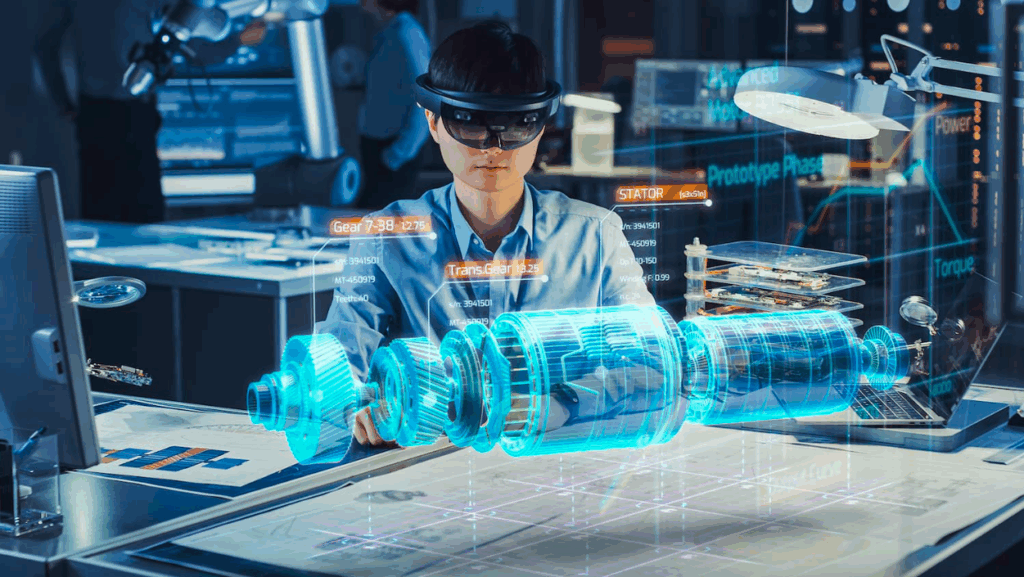
Between 2020 and 2025, the maturity of AR solutions accelerated significantly. Thanks to advancements in 5G, edge computing, spatial computing, and AI integration, AR has moved from pilot projects into enterprise-wide deployments.
Industry leaders across automotive, aerospace, electronics, and heavy equipment have embraced AR to address long-standing pain points such as complex machinery, human error, long training cycles, and rising customization demands. Today’s AR systems are no longer isolated apps but part of connected ecosystems integrated with Digital Twins, MES (Manufacturing Execution Systems), and IIoT (Industrial Internet of Things) platforms.
In 2025, AR is not an optional add-on. It is a foundational capability in modern smart factories.
Key Benefits of AR in Manufacturing Efficiency
The key benefits of AR in manufacturing are outlined below:
Real-Time Operational Guidance
AR-enabled wearables and smart glasses provide operators with visual overlays of instructions, component layouts, and safety warnings directly in their line of sight. This eliminates the need to reference paper manuals or screens, reducing task-switching time and cognitive load.
New hires can be trained faster with guided workflows and simulations, dramatically reducing onboarding time and human error. In some cases, training cycles have dropped from weeks to days.
Example: A Tier 1 automotive supplier used AR to guide assembly line workers in real time, achieving a 30% reduction in assembly errors and a 40% cut in training time.
Predictive Maintenance and Asset Uptime
With the integration of AR and IIoT data, technicians can visualize the health status of machines in real time. AR overlays display temperature, vibration, and performance metrics sourced from sensors, helping identify anomalies before they escalate into failures.
AR-assisted maintenance routines reduce diagnostic time and ensure adherence to standard operating procedures (SOPs), ultimately increasing asset uptime and reducing maintenance costs.
Example: A chemical plant used AR dashboards to assist field technicians in identifying wear on rotating equipment. Result: 22% improvement in mean time between failures (MTBF).
Remote Collaboration and Expert Assistance
In a globalized manufacturing environment, accessing domain experts on-site can be costly and time-consuming. AR bridges this gap.
Remote experts can connect via AR platforms to see what frontline workers see, annotate directly onto their visual feed, and guide them step-by-step through complex procedures. This drastically reduces equipment downtime and avoids unnecessary travel.
Example: A multinational electronics firm reduced average repair time for field machinery by 35% through AR-enabled remote diagnostics and support.
AR for Design Iteration and Quality Control
Design engineers and QA teams can use AR to project 3D CAD models onto physical prototypes or components, enabling real-time comparison between design and reality. Misalignments or defects can be spotted early in the development cycle before costly rework becomes necessary.
AR also enhances quality inspections by overlaying measurement data, tolerances, and pass/fail indicators directly onto parts, ensuring faster and more consistent inspection routines.
Example: An aerospace manufacturer reduced prototype development time by 25% using AR-assisted design reviews and live annotation tools.
Real-World Success Stories of AR in Manufacturing
The adoption of AR in manufacturing has shifted from experimental pilots to enterprise-scale deployments across leading industrial sectors. Below are some notable case studies that demonstrate how AR is delivering tangible results in real production environments:
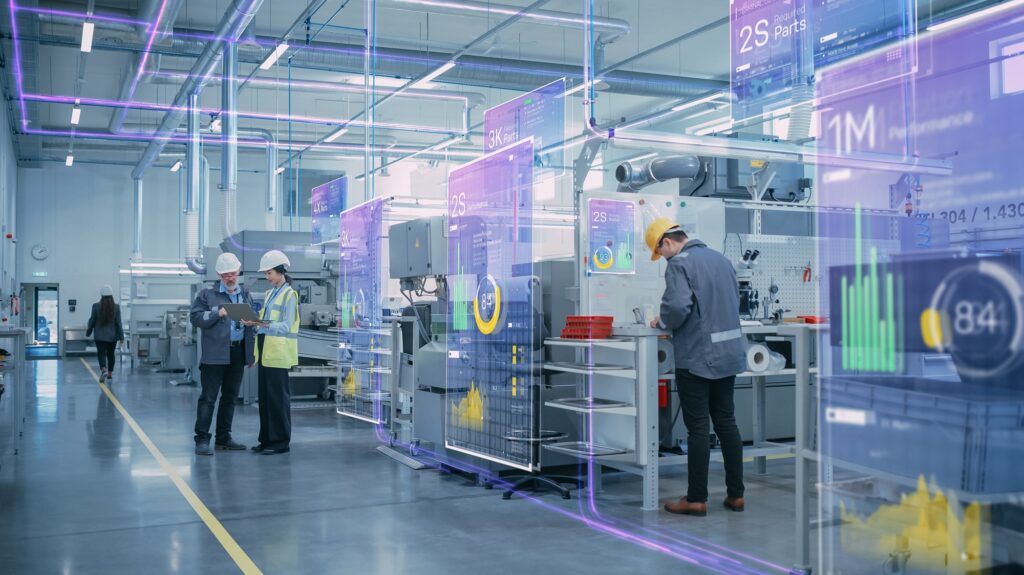
Boeing: Enhancing Wire Harness Assembly
Boeing implemented AR smart glasses to guide technicians during the intricate process of assembling wire harnesses in aircraft. Workers received real-time visual instructions overlaid directly onto the work surface, eliminating the need to consult static manuals.
GE Healthcare: Reducing Technician Training Time
GE Healthcare uses AR to train its field service engineers on advanced medical imaging equipment. Through immersive AR modules, technicians interact with 3D equipment models, simulate repairs, and rehearse maintenance workflows before ever touching the actual machines.
Airbus: Streamlining Aircraft Assembly
Airbus integrated AR into its fuselage assembly processes, using tablets and smart glasses to project 3D part locations and installation steps. Assembly technicians follow step-by-step visual workflows while simultaneously validating component positions in real time.
Porsche: Revolutionizing Remote Maintenance
Porsche uses AR glasses to enable dealership mechanics to connect directly with factory-based specialists in Germany. The remote experts see exactly what the mechanic sees, offering real-time guidance, annotations, and diagnostics.
Challenges and Considerations
Despite its benefits, AR adoption is not without hurdles
- Upfront investment: AR hardware, software platforms, and integration services can be capital intensive
- Connectivity requirements: Real-time AR performance demands robust infrastructure including low-latency networks, cloud access, and device compatibility
- Workforce adoption: Cultural resistance, lack of digital skills, and the need for training are major challenges. Successful adoption requires change management and user-centric design
Enterprises must evaluate readiness across these dimensions to ensure a smooth AR deployment and maximize value.
Looking Ahead: The Future of AR in Manufacturing
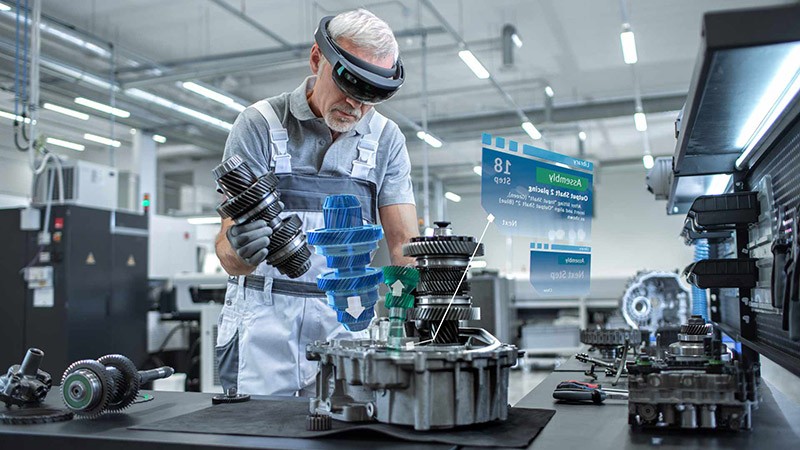
As AR technology continues to mature, its role in manufacturing is expected to expand significantly. Improvements in hardware such as lighter headsets, wider fields of view, and longer battery life will enhance usability on the factory floor. On the software side, tighter integration with AI, IoT, and digital twins will make AR systems more intelligent, adaptive, and predictive.
Manufacturers will increasingly use AR not just for visual guidance but for closed-loop operations where AR interfaces respond in real time to sensor data and human input. As a result, decision-making will become faster, safer, and more data-driven.
In the next few years, we can expect to see:
- Broader adoption among small and medium manufacturers
- Industry-specific AR platforms optimized for complex tasks
- Greater emphasis on security, standardization, and interoperability
Ultimately, AR is poised to become a core pillar of smart manufacturing, enabling more agile, efficient, and resilient operations in a highly competitive global market.
Final Thoughts
Augmented Reality is rapidly becoming a cornerstone of modern manufacturing, delivering measurable improvements in productivity, precision, and workforce enablement. As the technology matures and integrates with AI, IoT, and real-time data systems, its impact on factory efficiency will only grow stronger. Manufacturers that adopt AR now are positioning themselves for long-term agility and competitiveness.
At Sphinx JSC, we specialize in developing intelligent AR-powered solutions tailored to the needs of industrial environments. From consulting to implementation, we help manufacturers transform their operations with scalable, future-ready technology. Get in touch with our team to explore how AR can unlock new value on your production floor and accelerate your journey toward smart manufacturin



CEO - Son Le
기타 블로그
블로그
AI Chatbot Applications: Benefits, Use Cases, and Future Trends
Artificial Intelligence (AI) is rapidly transforming the way businesses communicate with customers, automate workflows, and deliver personalized experiences. At the center of this transformation is the AI chatbot, an intelligent virtual assistant capable of understanding natural language, answering questions, and supporting users across websites, mobile apps, and messaging platforms. As...
자세히 보기블로그
How AI Is Revolutionizing Hotel Operations and Revenue
The hospitality industry is undergoing one of its biggest transformations in decades. As guest expectations continue to rise and operational costs increase, hotels are turning to Artificial Intelligence (AI) to stay competitive. From maximizing room revenue to delivering personalized guest experiences, AI is no longer a futuristic concept. It has...
자세히 보기블로그
AI Chatbots in Hospitality: Drive Bookings & Better Service
The hospitality industry is rapidly embracing AI as guest expectations continue to evolve. Today’s travelers expect instant responses, personalized recommendations, and seamless communication throughout their booking journey. To meet these demands while improving operational efficiency, more hotels are turning to AI chatbots. Modern AI chatbots do far more than answer...
자세히 보기기타 블로그
서비스
IoT 개발
SphinX는 최첨단 IoT 개발 서비스를 제공하여 디바이스를 원활하게 연결하고 혁신적인 솔루션을 제공합니다.
테마서비스
블록체인 개발
우리는 신뢰할 수 있고 안전한 블록체인 기술을 처음부터 설계하는 데 매우 능숙하며, ...
테마서비스
ERP 및 CRM 개발
필요한 ERP & CRM 개발 서비스! 비즈니스 프로세스 간소화 및 조직 효율성 향상....
테마기타 블로그
서비스
IoT 개발
SphinX는 최첨단 IoT 개발 서비스를 제공하여 디바이스를 원활하게 연결하고 혁신적인 솔루션을 제공합니다.
테마서비스
블록체인 개발
우리는 신뢰할 수 있고 안전한 블록체인 기술을 처음부터 설계하는 데 매우 능숙하며, ...
테마서비스
ERP 및 CRM 개발
필요한 ERP & CRM 개발 서비스! 비즈니스 프로세스 간소화 및 조직 효율성 향상....
테마