


Artificial Intelligence (AI) is no longer just a futuristic concept in software development. It is becoming a practical technology that is changing how websites and web applications are designed, built, tested, and maintained.
From generating code snippets to improving user experiences, AI in Web Development is helping developers work faster and solve complex problems more efficiently. However, AI is not simply replacing traditional development processes. Instead, it is becoming a powerful assistant that allows developers to focus more on creativity, problem-solving, and strategic decisions.
As AI tools continue to evolve, developers need to understand how this technology impacts their workflows, its current limitations, and what skills will matter in the future.
Key Advantages Developers Should Know
AI brings significant improvements to different stages of web development, from planning and coding to optimization and maintenance. By automating repetitive tasks and providing intelligent recommendations, AI helps developers increase productivity while reducing development time.
Faster Development Process
One of the biggest advantages of AI in web development is improved speed. AI-powered tools can generate code suggestions, create reusable components, and assist with debugging, allowing developers to complete tasks faster.
Instead of spending hours writing repetitive code, developers can use AI assistants to handle basic implementation tasks and focus on more complex aspects such as architecture, user experience, and performance optimization.
This does not eliminate the need for coding skills. Developers still need to understand logic, frameworks, and best practices to review and improve AI-generated results.
Better Code Quality and Error Detection
AI tools can analyze code patterns, identify potential bugs, and suggest improvements before issues affect the final product.
Through machine learning algorithms, AI can detect common programming mistakes, security risks, or inefficient code structures. This helps development teams maintain cleaner codebases and reduce time spent on manual reviews.
Enhanced User Experience
Modern websites need to provide personalized and seamless experiences. AI helps developers create smarter web applications by analyzing user behavior and delivering more relevant content.
For example, AI can support:
- Personalized recommendations
- Intelligent search functions
- Chatbots and virtual assistants
- Adaptive website interfaces
These features allow businesses to create more engaging digital experiences for users.
Improved Testing and Maintenance
Testing is an essential but time-consuming part of web development. AI can automate many testing processes, including identifying UI issues, analyzing performance problems, and predicting potential failures. AI-powered testing tools help developers release more reliable applications while reducing manual effort.
7 Ways AI Is Transforming the Web Development Process
AI is no longer limited to simple code generation. Today, AI is being integrated into different stages of web development, helping developers improve productivity, optimize performance, and build smarter digital experiences. From writing code to maintaining applications after launch, AI is changing how modern websites and web applications are developed.
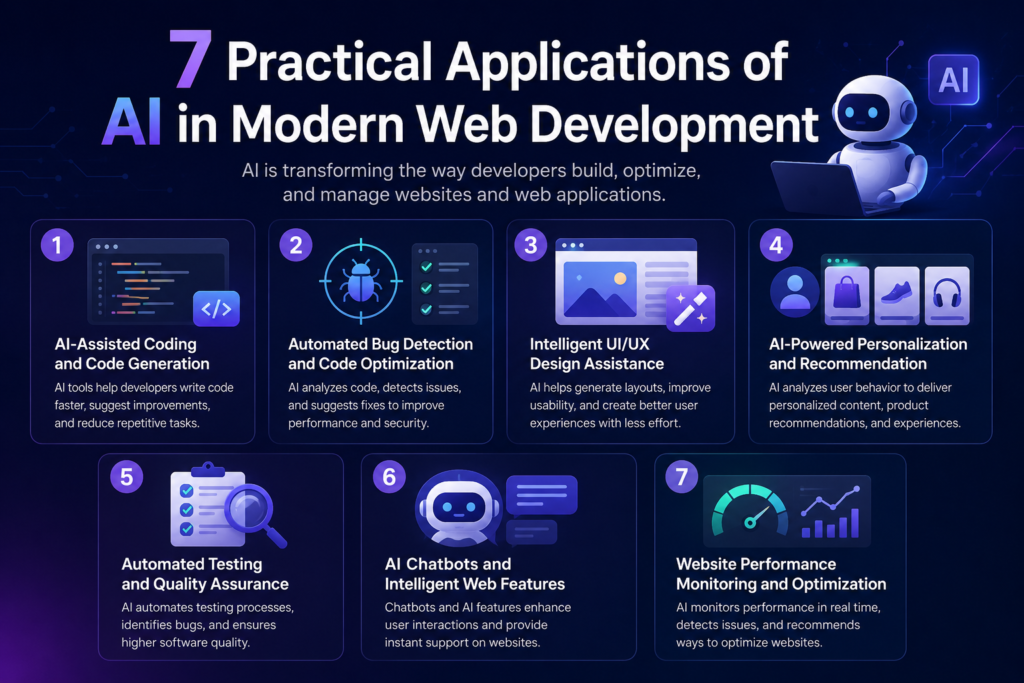
AI-Assisted Coding and Code Generation
One of the most common applications of AI in web development is assisting developers during the coding process. AI-powered coding assistants can generate code snippets, suggest improvements, explain complex functions, and help developers solve programming problems faster.
For example, developers can describe a feature they want to build, such as creating a user authentication system or designing an API endpoint, and AI can provide a starting point with relevant code suggestions.
This does not mean developers no longer need programming skills. Instead, AI works as a productivity tool that reduces repetitive coding tasks and allows developers to focus more on system logic, architecture, and problem-solving.
Common use cases include:
- Generating HTML, CSS, JavaScript, or framework-based code
- Creating reusable components
- Explaining unfamiliar code structures
- Converting code between programming languages
Automated Bug Detection and Code Optimization
Debugging is one of the most time-consuming parts of web development. AI helps developers identify errors faster by analyzing code patterns and detecting potential issues before they become major problems.
AI-powered tools can review code, find syntax mistakes, highlight security risks, and suggest optimization methods. This allows development teams to reduce debugging time and improve overall code quality.
For example, instead of manually reviewing thousands of lines of code, developers can use AI tools to quickly identify areas that may cause performance issues or unexpected behavior.
AI can support:
- Error detection
- Code review automation
- Performance improvement suggestions
- Security vulnerability analysis
Intelligent UI/UX Design Assistance
AI is also changing how developers approach website interfaces. Instead of starting every design element from scratch, teams can use AI to generate design ideas, create prototypes, and improve user interface decisions.
AI tools can analyze user behavior, identify usability issues, and suggest interface improvements based on existing data.
For example, AI can help determine where users are likely to interact most on a webpage or suggest better layouts to improve engagement.
Practical applications include:
- Generating UI design concepts
- Creating website prototypes
- Improving user navigation
- Suggesting accessibility improvements
AI-Powered Personalization and Recommendation Systems
Modern users expect websites to provide personalized experiences. AI enables websites to understand user behavior and deliver more relevant content, products, or recommendations.
E-commerce platforms, streaming services, and online platforms commonly use AI recommendation systems to analyze user activity and predict what users may need next.
For web developers, integrating AI personalization features can improve user engagement and create more dynamic experiences.
Examples include:
- Product recommendations
- Personalized content feeds
- Customized user dashboards
- Smart search results
Automated Testing and Quality Assurance
Testing is essential for ensuring websites work correctly across different devices, browsers, and user scenarios. AI helps automate parts of the testing process, making quality assurance faster and more efficient.
Instead of manually checking every feature, AI-powered testing tools can simulate user interactions, detect interface problems, and identify unexpected behaviors.
This is especially valuable for large-scale web applications where manual testing requires significant time and resources.
AI can help with:
- Automated UI testing
- Regression testing
- Cross-browser testing
- Detecting usability issues
AI Chatbots and Intelligent Web Features
AI-powered chatbots have become a common feature in modern websites, especially for businesses that need real-time customer support.
Developers can integrate AI chatbots into websites to answer customer questions, guide users through processes, and provide instant assistance without requiring constant human support.
Beyond customer service, AI can also power smarter website functions such as virtual assistants and conversational interfaces.
Common applications include:
- Customer support chatbots
- AI assistants
- Automated FAQ systems
- Lead generation tools
Website Performance Monitoring and Optimization
Website performance directly affects user experience, conversion rates, and search engine rankings. AI helps developers monitor website performance and identify opportunities for improvement.
By analyzing large amounts of technical data, AI can detect slow-loading pages, inefficient resources, and potential performance bottlenecks.
Developers can use these insights to optimize websites and maintain better performance over time.
AI supports areas such as:
- Page speed optimization
- Resource management
- Server performance analysis
- Predictive maintenance
Challenges of Using AI in Web Development
Although AI is becoming a powerful tool for modern web development, it still has limitations that developers need to understand. AI can improve efficiency and automate many tasks, but it cannot fully replace human judgment, technical expertise, and careful evaluation.
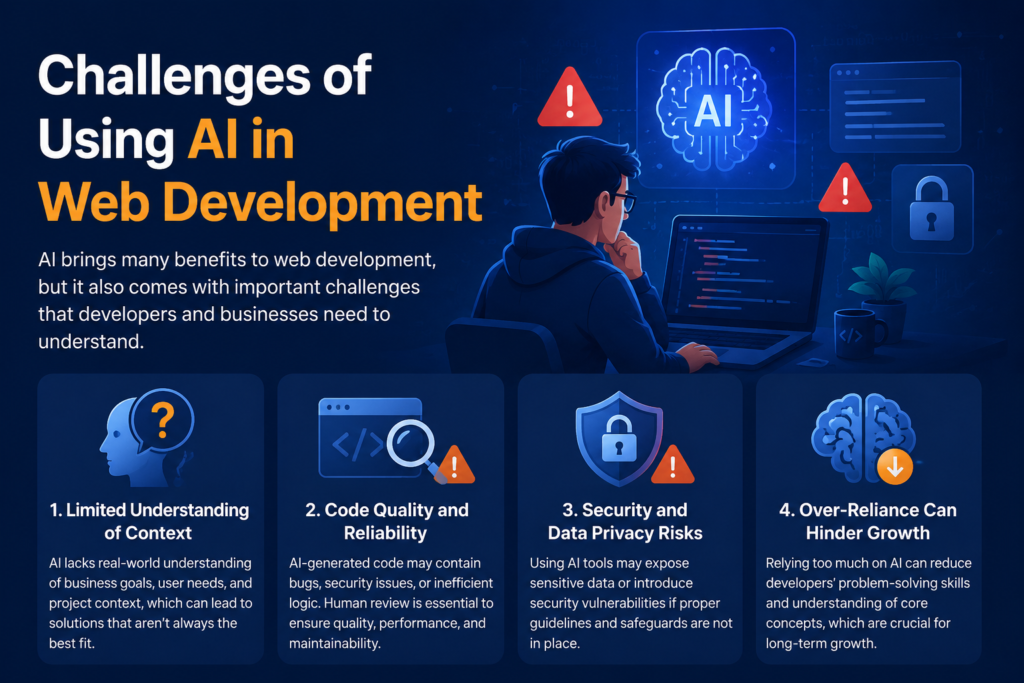
Limited Understanding and Decision-Making Ability
AI tools generate results based on patterns learned from existing data, but they do not have human intuition or the ability to fully understand complex project situations.
In web development, many decisions require more than technical solutions. Developers need to consider business goals, user behavior, scalability, and overall product strategy. AI can provide suggestions, but human developers are still responsible for choosing the most suitable approach and making final decisions.
Potential Issues with Data Quality and Bias
The effectiveness of AI depends heavily on the quality of the data used during training. If the training data contains errors, outdated information, or biased patterns, AI may generate inaccurate recommendations or unsuitable solutions.
For web development teams, this means AI-generated code, designs, or suggestions should always be reviewed carefully. Human oversight is necessary to ensure the results are reliable, secure, and aligned with project requirements.
Resource and Performance Limitations of AI Models
Not every AI model is suitable for every web development environment. Some advanced AI systems require significant computing resources, which can create challenges when building lightweight applications or deploying AI features on devices with limited capacity.
Developers need to evaluate factors such as performance, cost, scalability, and infrastructure requirements before integrating AI into a web application.
4AI Still Requires Human Expertise and Supervision
While AI can accelerate coding, testing, and optimization, it works best as a supporting tool rather than a replacement for developers.
Web development involves creativity, problem-solving, and continuous decision-making areas where human expertise remains essential. Developers who know how to combine AI capabilities with their technical knowledge will be able to create more effective and reliable solutions.
The Future of Web Development: Will AI Replace Developers?
The rapid adoption of AI in web development has raised a major question among developers and businesses: will AI eventually replace human programmers?
AI-powered tools can now generate code, automate testing, improve website performance, and support many tasks that once required manual effort. This has created concerns that traditional development roles may disappear. However, the future of web development is not simply a competition between humans and AI. Instead, AI is changing the way developers work and redefining the skills needed in the industry.
AI Will Change the Way Developers Build Websites
AI is becoming a valuable assistant throughout the development process. Developers can use AI tools to speed up coding, identify technical issues, generate ideas, and automate repetitive tasks that take significant time.
For example, instead of manually writing every line of basic code, developers can use AI to create initial solutions and then improve them based on project requirements. This allows teams to work more efficiently and focus their effort on higher-value activities such as system architecture, user experience, and product improvement.
Rather than replacing developers, AI is helping them become more productive by reducing repetitive workloads.
Why Human Developers Are Still Essential
Although AI can handle many technical tasks, it still has limitations when dealing with complex decisions and real-world challenges.
Successful web development requires more than producing functional code. Developers need to understand business goals, user expectations, security requirements, and long-term scalability. These decisions often depend on experience, creativity, and critical thinking areas where AI cannot operate independently.
For instance, AI may generate a website layout or suggest a technical solution, but it cannot fully understand a brand’s vision, customer behavior, or the unique goals of a product without human guidance.
AI Will Not Replace Developers, But It Will Transform Their Roles
The biggest impact of AI will be the evolution of the developer role. As AI handles more routine tasks, developers will likely spend less time on repetitive implementation and more time on strategic problem-solving.
Future developers may need stronger skills in areas such as:
- Designing scalable systems
- Integrating AI features into applications
- Evaluating AI-generated solutions
- Improving user experiences
- Making technical decisions based on business needs
The value of developers will shift from simply writing code to creating better solutions with the help of AI.
The Future Is Collaboration Between AI and Developers
The most likely future of web development is a collaborative model where AI and humans work together. AI can provide speed, automation, and technical assistance, while developers bring creativity, judgment, and a deeper understanding of users.
Developers who adapt to AI tools will have an advantage because they can complete projects faster and explore more innovative approaches. On the other hand, relying entirely on AI without technical knowledge can lead to problems related to quality, security, and maintainability.
Final Thoughts
AI will continue to reshape web development, but it will not replace developers entirely. Instead, it will change the way developers approach their work by automating repetitive tasks and allowing them to focus on creativity, problem-solving, and building better digital experiences.
At Sphinx JSC, we believe the future of web development comes from the collaboration between AI technology and human expertise. By using AI strategically alongside professional development skills, businesses can create smarter, more scalable, and high-performing web solutions that meet the needs of modern users.



CEO - Son Le
기타 블로그
블로그
AI Chatbot Applications: Benefits, Use Cases, and Future Trends
Artificial Intelligence (AI) is rapidly transforming the way businesses communicate with customers, automate workflows, and deliver personalized experiences. At the center of this transformation is the AI chatbot, an intelligent virtual assistant capable of understanding natural language, answering questions, and supporting users across websites, mobile apps, and messaging platforms. As...
자세히 보기블로그
How AI Is Revolutionizing Hotel Operations and Revenue
The hospitality industry is undergoing one of its biggest transformations in decades. As guest expectations continue to rise and operational costs increase, hotels are turning to Artificial Intelligence (AI) to stay competitive. From maximizing room revenue to delivering personalized guest experiences, AI is no longer a futuristic concept. It has...
자세히 보기블로그
AI Chatbots in Hospitality: Drive Bookings & Better Service
The hospitality industry is rapidly embracing AI as guest expectations continue to evolve. Today’s travelers expect instant responses, personalized recommendations, and seamless communication throughout their booking journey. To meet these demands while improving operational efficiency, more hotels are turning to AI chatbots. Modern AI chatbots do far more than answer...
자세히 보기기타 블로그
서비스
IoT 개발
SphinX는 최첨단 IoT 개발 서비스를 제공하여 디바이스를 원활하게 연결하고 혁신적인 솔루션을 제공합니다.
테마서비스
블록체인 개발
우리는 신뢰할 수 있고 안전한 블록체인 기술을 처음부터 설계하는 데 매우 능숙하며, ...
테마서비스
ERP 및 CRM 개발
필요한 ERP & CRM 개발 서비스! 비즈니스 프로세스 간소화 및 조직 효율성 향상....
테마기타 블로그
서비스
IoT 개발
SphinX는 최첨단 IoT 개발 서비스를 제공하여 디바이스를 원활하게 연결하고 혁신적인 솔루션을 제공합니다.
테마서비스
블록체인 개발
우리는 신뢰할 수 있고 안전한 블록체인 기술을 처음부터 설계하는 데 매우 능숙하며, ...
테마서비스
ERP 및 CRM 개발
필요한 ERP & CRM 개발 서비스! 비즈니스 프로세스 간소화 및 조직 효율성 향상....
테마