


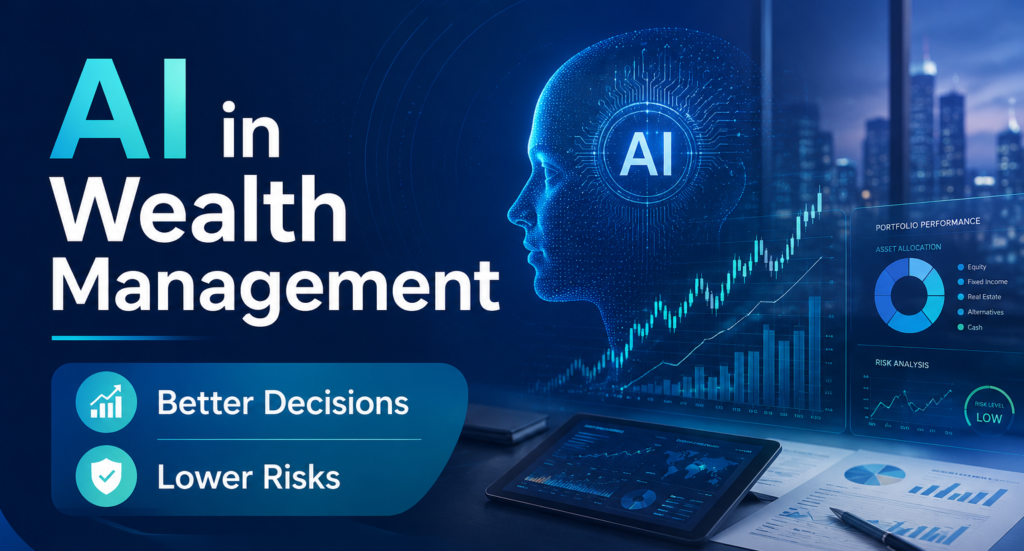
The wealth management industry has always been driven by data, market insights, and the ability to make informed financial decisions. However, as investment landscapes become more complex and client expectations continue to rise, traditional approaches are no longer enough. Wealth managers now need faster analysis, deeper personalization, and more accurate risk assessment.
This is where AI in Wealth Management is transforming the industry. By combining artificial intelligence, machine learning, predictive analytics, and automation, financial firms can improve decision-making, optimize portfolios, and deliver more personalized investment strategies while reducing potential risks.
From analyzing market trends to identifying investment opportunities, AI is becoming a powerful tool that helps wealth management firms operate more efficiently and serve clients more effectively.
AI in Wealth Management Industry Overview: Growth, Trends, and Opportunities
The adoption of AI in wealth management is accelerating as financial institutions recognize the value of intelligent technologies in improving investment outcomes. The growing availability of financial data, advances in machine learning models, and increasing demand for personalized services are driving AI adoption across the sector.
Unlike traditional wealth management methods that rely heavily on human analysis and historical data, AI systems can process massive amounts of information in real time. They can analyze market movements, economic indicators, customer behavior, and investment patterns to provide more accurate insights.
Several key trends are shaping the future of AI-powered wealth management:
Increased Demand for Personalized Investment Strategies
Modern investors expect solutions tailored to their financial goals, risk tolerance, and personal preferences. AI enables wealth managers to create customized portfolios by analyzing individual financial profiles and predicting future needs.
Instead of offering standardized investment recommendations, firms can use AI-driven insights to deliver more relevant and personalized advice.
Growth of AI-Powered Digital Advisors
Robo-advisors and AI-based financial platforms are becoming increasingly popular due to their ability to provide automated investment guidance. These platforms help investors manage portfolios, rebalance assets, and monitor performance with minimal human intervention.
For wealth management firms, AI-powered advisory tools create opportunities to serve more clients while reducing operational costs.
Greater Focus on Risk Management
Market uncertainty is one of the biggest challenges in wealth management. AI helps firms identify potential risks earlier by analyzing market signals, historical trends, and external factors.
Through predictive analytics, wealth managers can make proactive decisions rather than reacting to market changes after they occur.
Understanding Artificial Intelligence and Its Key Capabilities
Artificial intelligence refers to technologies that allow machines to simulate human intelligence, including learning, reasoning, problem-solving, and decision-making. In wealth management, AI is used to analyze financial data, automate processes, and generate actionable investment insights.
AI technologies commonly used in wealth management include:
Machine Learning
Machine learning enables systems to learn from historical data and improve their predictions over time. In investment management, machine learning models can identify patterns in market behavior, evaluate asset performance, and support portfolio optimization.
For example, AI algorithms can analyze thousands of financial variables to identify potential opportunities that may be difficult for humans to detect manually.
Natural Language Processing (NLP)
Natural Language Processing allows AI systems to understand and analyze human language. Wealth management firms use NLP to process financial reports, news articles, market commentary, and customer communications.
By analyzing large volumes of text-based information, AI can provide insights into market sentiment and emerging investment trends.
Predictive Analytics
Predictive analytics uses historical and real-time data to forecast future outcomes. In wealth management, it helps firms estimate market movements, evaluate investment risks, and improve financial planning strategies.
Automation
AI automation reduces the need for repetitive manual tasks such as data processing, reporting, compliance checks, and customer support.
This allows financial professionals to focus more on strategic planning and building stronger client relationships.
How AI Is Transforming Wealth Management Companies
AI is changing the way wealth management firms operate by improving efficiency, enhancing client experiences, and enabling more informed investment decisions.
Enhancing Portfolio Management
One of the biggest impacts of AI is its ability to improve portfolio management. AI systems can continuously analyze market conditions and recommend adjustments based on changing risks and opportunities.
Instead of relying only on periodic portfolio reviews, wealth managers can use AI-powered monitoring tools to make faster and more data-driven decisions.
Improving Client Personalization
Every investor has different financial goals, risk preferences, and investment expectations. AI allows wealth management firms to better understand clients by analyzing financial behavior, transaction history, and personal objectives.
With these insights, firms can provide more personalized recommendations and improve long-term client satisfaction.
Increasing Operational Efficiency
Wealth management involves many time-consuming processes, including reporting, compliance monitoring, and customer communication. AI automation helps reduce manual workloads and improves accuracy.
For example, AI tools can automatically generate reports, identify unusual account activities, and support advisors with real-time information.
Supporting Better Risk Assessment
Risk management is a critical part of wealth management. AI models can analyze multiple risk factors simultaneously, including market volatility, economic changes, and investment patterns.
This enables firms to identify potential challenges earlier and develop strategies to protect client assets.
How Does AI in Wealth Management Work?
AI in wealth management works through a step-by-step process that transforms financial data into meaningful insights for investment decisions. By combining data processing, machine learning, and predictive analytics, AI helps wealth management firms analyze complex information, identify risks, and create more personalized investment strategies.
Data Collection and Preparation
The first step in the AI process is collecting data from different financial sources. Wealth management firms use various types of information, including market data, economic indicators, client financial profiles, investment history, portfolio performance, and regulatory updates.
AI systems also analyze behavioral data, such as client preferences and investment patterns, to better understand individual financial needs.
Before being used for analysis, collected data needs to be cleaned, organized, and structured. This preparation stage ensures that AI models work with accurate and relevant information, improving the quality of investment insights.
Data Processing and Pattern Analysis
Once data is prepared, AI systems process large volumes of financial information to identify important patterns and trends.
Machine learning algorithms analyze historical data, market movements, and portfolio performance to detect relationships between different factors. This allows AI to uncover insights that may be difficult to identify through traditional analysis.
For example, AI can evaluate how market changes, economic conditions, or asset performance may impact investment strategies and portfolio outcomes.
AI Model Integration and Insight Generation
After analyzing data, AI models generate insights to support wealth management activities.
When advisors or investors need information about portfolio performance, investment opportunities, or risk levels, AI retrieves relevant data and processes it to provide recommendations.
These insights can support areas such as:
- Portfolio optimization
- Asset allocation decisions
- Risk assessment
- Investment planning
- Market trend analysis
AI helps wealth managers make faster and more data-driven decisions while still allowing human experts to provide strategic guidance.
Risk Analysis and Portfolio Optimization
Risk management is a key part of how AI supports wealth management.
AI systems continuously monitor market conditions, portfolio changes, and external factors to identify potential risks. By using predictive analytics, AI can detect early warning signals and help firms adjust investment strategies before risks become larger issues.
At the same time, AI can optimize portfolios by analyzing asset distribution, performance trends, and changing market conditions. This enables wealth managers to maintain strategies that better match client goals and risk preferences.
Continuous Learning and Performance Improvement
AI does not remain static after deployment. The system continuously improves by learning from new data, market changes, and previous outcomes.
Feedback from users and performance monitoring help AI models become more accurate and effective over time. Regular evaluation also ensures that AI-generated recommendations remain reliable and aligned with business requirements.
Through continuous learning, AI becomes a more powerful tool for supporting long-term investment decisions.
AI Deployment in Wealth Management Platforms
The final stage is integrating AI capabilities into wealth management platforms used by advisors and clients.
AI solutions can be deployed through cloud-based systems, financial applications, or customized platforms to provide real-time analysis and intelligent support.
Once implemented, AI enables wealth management firms to improve operational efficiency, deliver personalized services, and make investment decisions with greater confidence.
Risks and Challenges of Implementing AI in Wealth Management
Although AI offers significant benefits, implementing AI in wealth management also comes with several challenges that firms need to address.
Data Privacy and Security Concerns
AI systems require access to large amounts of sensitive financial information. Protecting client data from unauthorized access and cyber threats is a major priority.
Wealth management firms must establish strong security measures and comply with financial regulations to ensure responsible AI usage.
Lack of Transparency in AI Decisions
Some AI models operate like a “black box,” meaning their decision-making processes can be difficult to understand.
For financial services, transparency is essential because clients and regulators need to know why certain recommendations are made.
Dependence on Data Quality
AI performance depends heavily on the quality of the data it receives. Inaccurate, incomplete, or biased data can lead to unreliable insights and poor investment decisions.
Firms must invest in effective data management strategies to maximize AI accuracy.
Balancing AI and Human Expertise
While AI can analyze data and provide recommendations, human expertise remains important in wealth management.
Financial advisors play a crucial role in understanding client goals, managing complex situations, and building trust. The future of wealth management will likely involve collaboration between AI technologies and human professionals.
Final Thoughts
AI in Wealth Management is reshaping the financial industry by improving decision-making, enhancing risk management, and enabling more personalized investment strategies. However, successful AI adoption requires a balance between advanced technology, reliable data, and human expertise.
As AI continues to evolve, wealth management firms that integrate AI effectively will gain greater efficiency and deliver better experiences for their clients.
At Sphinx JSC, we help businesses leverage AI solutions to optimize processes, improve decision-making, and build smarter digital solutions for the future.



CEO - Son Le
기타 블로그
블로그
AI Chatbot Applications: Benefits, Use Cases, and Future Trends
Artificial Intelligence (AI) is rapidly transforming the way businesses communicate with customers, automate workflows, and deliver personalized experiences. At the center of this transformation is the AI chatbot, an intelligent virtual assistant capable of understanding natural language, answering questions, and supporting users across websites, mobile apps, and messaging platforms. As...
자세히 보기블로그
How AI Is Revolutionizing Hotel Operations and Revenue
The hospitality industry is undergoing one of its biggest transformations in decades. As guest expectations continue to rise and operational costs increase, hotels are turning to Artificial Intelligence (AI) to stay competitive. From maximizing room revenue to delivering personalized guest experiences, AI is no longer a futuristic concept. It has...
자세히 보기블로그
AI Chatbots in Hospitality: Drive Bookings & Better Service
The hospitality industry is rapidly embracing AI as guest expectations continue to evolve. Today’s travelers expect instant responses, personalized recommendations, and seamless communication throughout their booking journey. To meet these demands while improving operational efficiency, more hotels are turning to AI chatbots. Modern AI chatbots do far more than answer...
자세히 보기기타 블로그
서비스
IoT 개발
SphinX는 최첨단 IoT 개발 서비스를 제공하여 디바이스를 원활하게 연결하고 혁신적인 솔루션을 제공합니다.
테마서비스
블록체인 개발
우리는 신뢰할 수 있고 안전한 블록체인 기술을 처음부터 설계하는 데 매우 능숙하며, ...
테마서비스
ERP 및 CRM 개발
필요한 ERP & CRM 개발 서비스! 비즈니스 프로세스 간소화 및 조직 효율성 향상....
테마기타 블로그
서비스
IoT 개발
SphinX는 최첨단 IoT 개발 서비스를 제공하여 디바이스를 원활하게 연결하고 혁신적인 솔루션을 제공합니다.
테마서비스
블록체인 개발
우리는 신뢰할 수 있고 안전한 블록체인 기술을 처음부터 설계하는 데 매우 능숙하며, ...
테마서비스
ERP 및 CRM 개발
필요한 ERP & CRM 개발 서비스! 비즈니스 프로세스 간소화 및 조직 효율성 향상....
테마