


Artificial intelligence is rapidly reshaping the retail landscape, changing how businesses interact with customers, manage operations, and drive growth. From personalized shopping experiences to automated supply chains, AI is no longer a future concept but a practical tool that retailers are actively using to stay competitive in an increasingly digital market.
This blog explores how AI is applied in retail today, highlighting key use cases, operational transformations, and measurable business benefits. It also examines the challenges retailers may face when adopting AI and provides guidance on choosing the right technology partner, helping businesses understand how to successfully integrate AI into their long term strategy.
What Is AI in Retail?
AI in retail refers to the use of artificial intelligence to improve how retailers understand customers, manage operations, and make decisions. By analyzing large volumes of data in real time, AI enables businesses to predict demand, personalize shopping experiences, and automate repetitive processes, helping them operate more efficiently and competitively.
Key Technologies Used
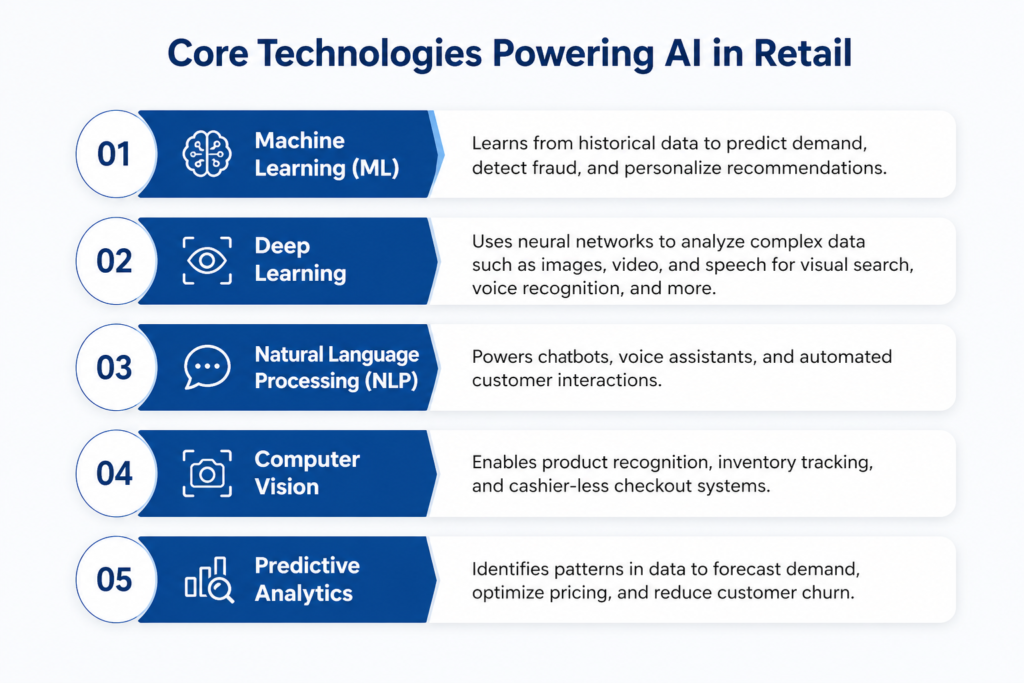
Several core technologies power AI in retail today:
AI vs Traditional Retail
As retail continues to evolve, the gap between traditional and AI-powered models is becoming increasingly clear. Businesses that rely on manual processes often struggle to keep up with changing customer expectations and market dynamics. In contrast, AI enables faster decision-making, better scalability, and more personalized experiences.
The comparison below highlights the key differences that define how modern retailers operate and compete in a data-driven environment.
| Feature | Traditional Retail | AI-Powered Retail |
|---|---|---|
| Decision Making | Based on past data and human intuition | Real-time, data-driven, and predictive |
| Scalability | Limited, requires significant manual resources | Highly scalable through automation and AI systems |
| Demand Forecasting | Reactive and often inaccurate | Predictive, using machine learning models |
| Personalization | Generic customer experience | Tailored recommendations based on user behavior |
| Customer Support | Human agents, limited availability | 24/7 AI chatbots and virtual assistants |
Why AI in Retail Is Transforming the Industry
AI is not just improving retail, it is fundamentally changing how the industry operates and competes. Below are the key reasons why AI is becoming a core driver of transformation in retail.
Rising Customer Expectations
Today’s customers expect fast, seamless, and highly personalized experiences across every touchpoint. AI enables retailers to understand individual preferences and deliver relevant recommendations, making each interaction more meaningful and engaging.
Explosion of Data
Retailers now have access to massive amounts of data from online and offline channels. AI helps process and analyze this data in real time, turning it into actionable insights that support better decision-making.
Need for Real-Time Decision Making
Market conditions, customer behavior, and demand can change rapidly. AI allows retailers to respond instantly with dynamic pricing, inventory adjustments, and personalized offers, instead of relying on delayed, manual decisions.
Increasing Competition
The retail market is more competitive than ever, especially with the growth of e-commerce. AI gives businesses a competitive edge by improving efficiency, reducing costs, and enhancing customer experience.
Operational Complexity
Managing supply chains, inventory, and multiple sales channels is increasingly complex. AI simplifies these operations through automation and predictive capabilities, helping retailers run more efficiently at scale.
Shift Toward Omnichannel Retail
Customers interact with brands across websites, mobile apps, social media, and physical stores. AI enables a consistent and connected experience across all these channels by unifying customer data and interactions.
Key Use Cases of AI in Retail
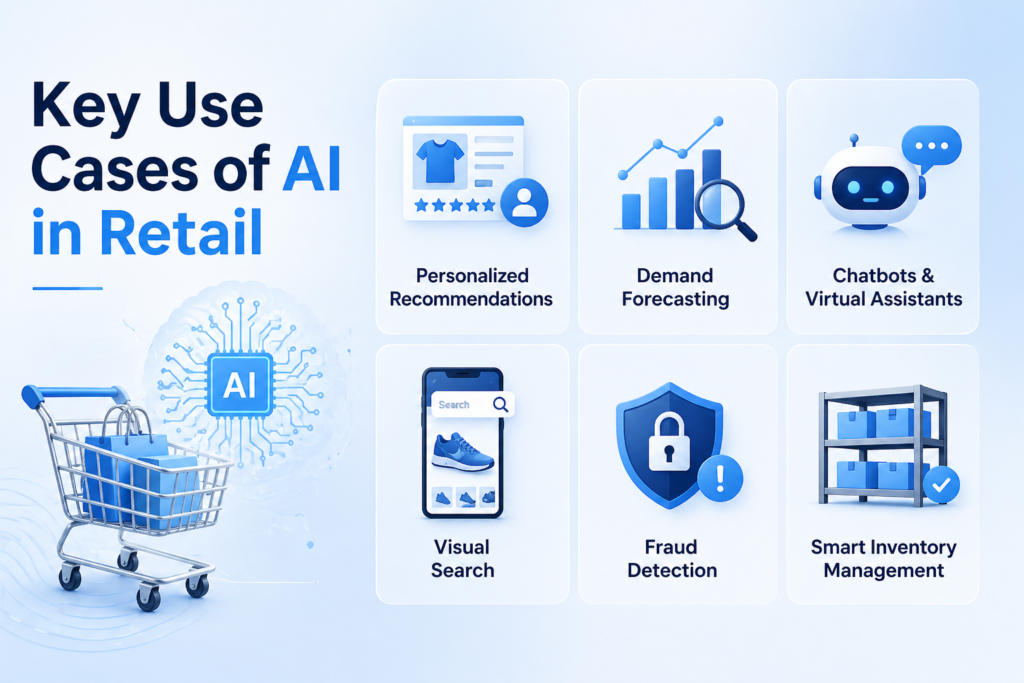
AI is being applied across multiple areas in retail, delivering measurable impact:
Personalized Recommendations
AI analyzes browsing history, purchase behavior, and preferences to suggest relevant products, increasing conversion rates and customer satisfaction.
Demand Forecasting
Machine learning models predict future demand based on historical data, seasonality, and trends, helping retailers avoid overstocking or stockouts.
Chatbots & Virtual Assistants
AI-powered chatbots provide instant customer support, answer queries, and guide users through their shopping journey 24/7.
Visual Search
Customers can upload images to find similar products, improving product discovery and engagement.
Fraud Detection
AI identifies unusual patterns in transactions to prevent fraud and protect both businesses and customers.
Smart Inventory Management
Computer vision and AI systems track inventory in real time, reducing human errors and improving efficiency.
How AI in Retail Is Transforming Operations
AI is reshaping retail operations from end to end:
- Supply Chain Optimization: AI predicts disruptions and optimizes logistics routes
- Pricing Strategies: Dynamic pricing adjusts in real time based on demand and competition
- Store Operations: Automated checkout systems reduce wait times and labor costs
- Marketing Automation: AI delivers targeted campaigns based on customer behavior
These improvements lead to faster, more efficient, and more scalable operations.
Benefits of AI in Retail
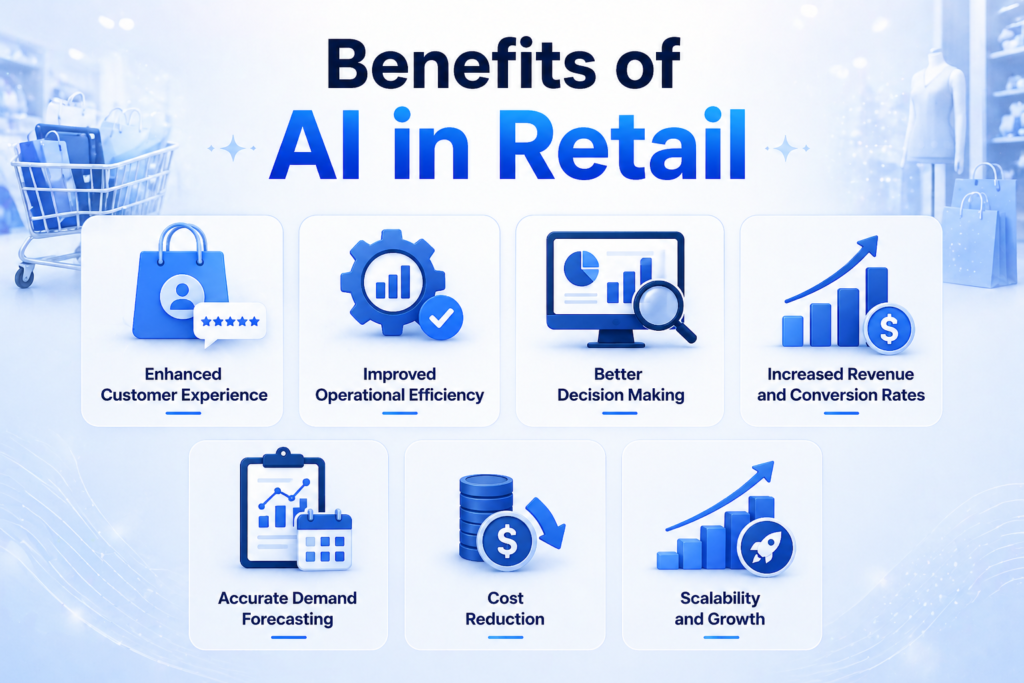
AI is delivering tangible value across the retail ecosystem, helping businesses improve performance, reduce costs, and create better customer experiences. Below are the key benefits that make AI a strategic investment for modern retailers.
Enhanced Customer Experience
AI enables retailers to deliver highly personalized and seamless shopping journeys. By analyzing customer behavior and preferences, businesses can recommend relevant products, tailor promotions, and create more engaging interactions across channels.
Improved Operational Efficiency
Automation powered by AI reduces the need for manual processes in areas such as inventory management, customer support, and order processing. This helps retailers save time, minimize errors, and allocate resources more effectively.
Better Decision Making
AI transforms large volumes of data into actionable insights. Retailers can make faster and more informed decisions based on real-time analytics, rather than relying solely on historical data or intuition.
Increased Revenue and Conversion Rates
With personalized recommendations, dynamic pricing, and targeted marketing, AI helps improve conversion rates and average order value. This directly contributes to revenue growth and stronger customer retention.
Accurate Demand Forecasting
AI-driven forecasting models analyze trends, seasonality, and external factors to predict demand more accurately. This reduces the risk of overstocking or stockouts and ensures better inventory planning.
Cost Reduction
By optimizing supply chains, automating workflows, and improving resource allocation, AI helps retailers significantly reduce operational costs while maintaining efficiency.
Scalability and Growth
AI systems can easily scale alongside business growth. Whether handling more customers, products, or data, AI enables retailers to expand operations without a proportional increase in resources.
Challenges of AI in Retail
While AI offers significant advantages, its adoption in retail is not without challenges. Businesses need to carefully navigate both technical and strategic barriers to fully realize its value.
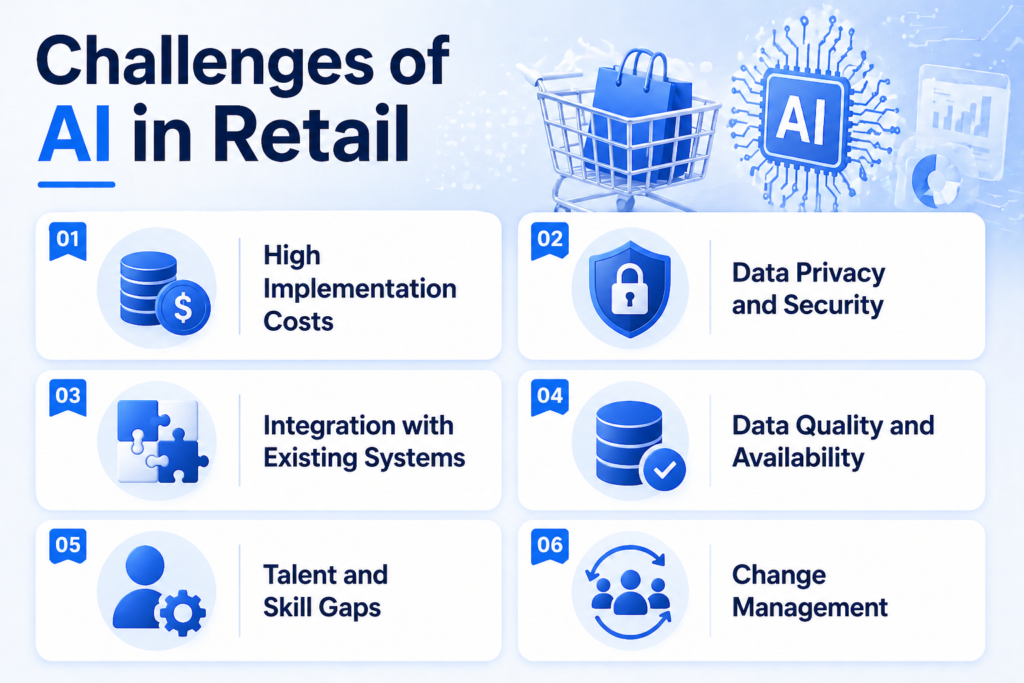
High Implementation Costs
Deploying AI solutions often requires substantial investment in infrastructure, software, and talent. For many retailers, especially small and mid-sized businesses, the upfront cost can be a major barrier.
Data Privacy and Security
AI relies heavily on customer data, which raises concerns about privacy and compliance. Retailers must ensure they follow data protection regulations and maintain customer trust while using AI-driven insights.
Integration with Existing Systems
Many retailers operate on legacy systems that are not designed to work with modern AI technologies. Integrating AI into these systems can be complex, time-consuming, and costly.
Data Quality and Availability
AI systems are only as good as the data they are trained on. Incomplete, outdated, or inconsistent data can lead to inaccurate predictions and poor decision-making.
Talent and Skill Gaps
Implementing and managing AI requires specialized skills in data science, machine learning, and engineering. Finding and retaining qualified talent remains a challenge for many organizations.
Change Management
Adopting AI often requires a shift in mindset and workflows. Employees may resist change or struggle to adapt to new technologies, making it essential for businesses to invest in training and internal alignment.
How to Choose the Right AI Partner for AI in Fintech
Although this section focuses on fintech, the same principles apply to retail AI partnerships:
- Industry Expertise: Choose a partner with proven experience in your domain
- Scalability: Ensure the solution can grow with your business
- Customization: Avoid one-size-fits-all solutions; look for tailored approaches
- Data Security: Verify compliance with data protection standards
- Integration Capability: The solution should integrate smoothly with your existing systems
Future of AI in Retail
AI in retail is shifting from basic automation to more intelligent and experience-driven applications. In the near future, it will play a central role in how retailers operate and engage with customers.
Key Trends
- Hyper-personalization: Real-time, tailored experiences across the customer journey
- Automation at scale: Smarter supply chains, inventory, and store operations
- Omnichannel integration: Seamless experiences across online and offline channels
- Conversational commerce: Growth of chatbots and voice-based shopping
- Immersive shopping: Integration with AR and VR for better product visualization
AI is becoming a core capability in retail, helping businesses adapt faster and stay competitive in a rapidly evolving market.
Conclusion
AI is rapidly becoming a core driver of innovation in retail, helping businesses enhance customer experience, optimize operations, and stay competitive in a fast-changing market. Those who adopt AI strategically will be better positioned to scale and lead in the future.
If you’re looking to build AI-powered retail solutions, Sphinx JSC can help you design and deploy scalable, end-to-end systems tailored to your business needs. Reach out to explore how AI can transform your retail strategy.



CEO - Son Le
기타 블로그
블로그
AI Chatbot Applications: Benefits, Use Cases, and Future Trends
Artificial Intelligence (AI) is rapidly transforming the way businesses communicate with customers, automate workflows, and deliver personalized experiences. At the center of this transformation is the AI chatbot, an intelligent virtual assistant capable of understanding natural language, answering questions, and supporting users across websites, mobile apps, and messaging platforms. As...
자세히 보기블로그
How AI Is Revolutionizing Hotel Operations and Revenue
The hospitality industry is undergoing one of its biggest transformations in decades. As guest expectations continue to rise and operational costs increase, hotels are turning to Artificial Intelligence (AI) to stay competitive. From maximizing room revenue to delivering personalized guest experiences, AI is no longer a futuristic concept. It has...
자세히 보기블로그
AI Chatbots in Hospitality: Drive Bookings & Better Service
The hospitality industry is rapidly embracing AI as guest expectations continue to evolve. Today’s travelers expect instant responses, personalized recommendations, and seamless communication throughout their booking journey. To meet these demands while improving operational efficiency, more hotels are turning to AI chatbots. Modern AI chatbots do far more than answer...
자세히 보기기타 블로그
서비스
IoT 개발
SphinX는 최첨단 IoT 개발 서비스를 제공하여 디바이스를 원활하게 연결하고 혁신적인 솔루션을 제공합니다.
테마서비스
블록체인 개발
우리는 신뢰할 수 있고 안전한 블록체인 기술을 처음부터 설계하는 데 매우 능숙하며, ...
테마서비스
ERP 및 CRM 개발
필요한 ERP & CRM 개발 서비스! 비즈니스 프로세스 간소화 및 조직 효율성 향상....
테마기타 블로그
서비스
IoT 개발
SphinX는 최첨단 IoT 개발 서비스를 제공하여 디바이스를 원활하게 연결하고 혁신적인 솔루션을 제공합니다.
테마서비스
블록체인 개발
우리는 신뢰할 수 있고 안전한 블록체인 기술을 처음부터 설계하는 데 매우 능숙하며, ...
테마서비스
ERP 및 CRM 개발
필요한 ERP & CRM 개발 서비스! 비즈니스 프로세스 간소화 및 조직 효율성 향상....
테마