


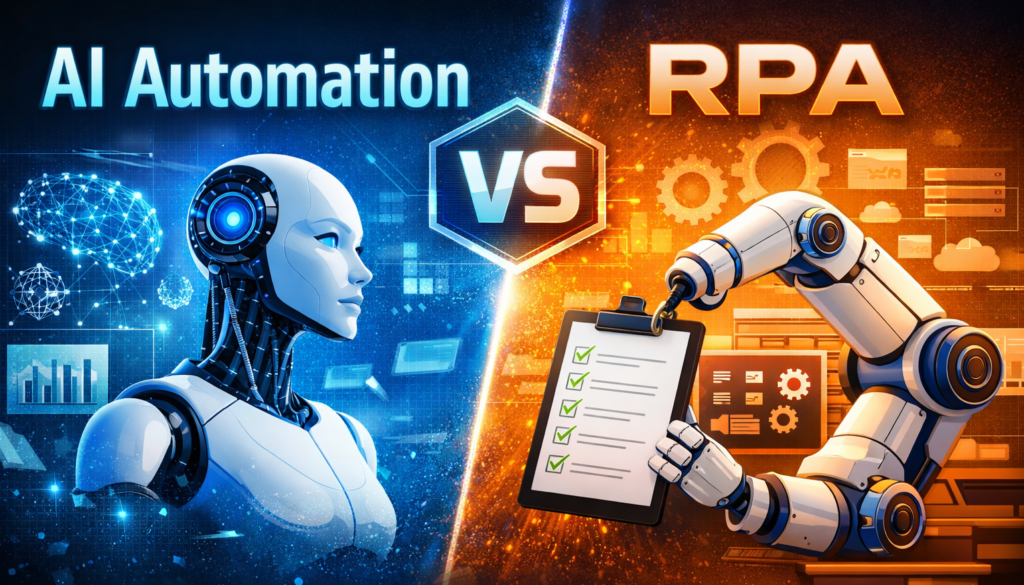
In recent years, businesses have been accelerating automation initiatives to improve efficiency, reduce operational costs, and strengthen their competitive advantage. As the volume of data and operational processes continues to grow in complexity, traditional automation technologies are no longer sufficient to meet the demands of modern organizations.
Two of the most widely discussed solutions today are Robotic Process Automation (RPA) 그리고 AI Automation. Although both aim to automate business processes, they differ significantly in how they operate and the types of tasks they can handle.
While RPA focuses on automating repetitive, rule-based tasks, AI Automation is capable of analyzing data, recognizing patterns, and supporting decision-making processes. These differences often make it challenging for businesses to determine which technology best fits their digital transformation strategy.
This blog will help you understand the key differences between AI Automation vs RPA, explore common use cases, and learn how to choose the right approach for your business needs.
What Is RPA (Robotic Process Automation)?
Robotic Process Automation (RPA) is a technology that uses software robots, commonly known as bots, to automate repetitive and rule-based digital tasks. These bots are designed to mimic human interactions with software applications, allowing them to perform tasks such as entering data, copying information, processing transactions, and generating reports.
RPA is primarily used to automate structured processes where the rules and workflows are clearly defined. Because it operates based on predefined instructions, RPA can execute tasks consistently and accurately without requiring human intervention.
How RPA Works
RPA bots interact with enterprise systems through the user interface in the same way employees do. They can log into applications, extract data from files or databases, perform calculations, and move information between systems. This interface-level interaction allows organizations to implement RPA without significantly modifying existing IT infrastructure. As a result, businesses can deploy automation quickly and scale it across multiple processes.
Key Characteristics of RPA
Several characteristics define the core functionality of RPA technology:
- Rule-based automation with predefined workflows
- Ability to process structured data efficiently
- High accuracy in repetitive tasks
- Fast implementation compared to traditional system integration
- Scalability across multiple digital processes
자세히 보기 로보틱 프로세스 자동화의 10가지 비즈니스 이점
What Is AI Automation?
AI Automation refers to the use of artificial intelligence technologies to automate business processes that require analysis, interpretation, and decision-making. Unlike traditional automation tools that rely on predefined rules, AI-powered systems can process large volumes of data, recognize patterns, and continuously improve their performance over time.
By combining automation with intelligence, AI Automation enables organizations to move beyond simple task execution and automate more complex workflows that involve reasoning, prediction, and data-driven insights.
How AI Automation Works
AI Automation integrates multiple artificial intelligence technologies into automated workflows. These systems collect and analyze data, apply machine learning models, and generate insights that guide automated actions.
For example, an AI-powered system can analyze documents, identify relevant information, and trigger automated processes based on the extracted data. Over time, machine learning models improve accuracy by learning from historical data and previous outcomes. This ability to analyze and learn from data allows AI Automation to handle processes that are dynamic, data-intensive, and less predictable.
Key Characteristics of AI Automation
AI Automation differs from traditional automation tools in several important ways.
- Ability to process both structured and unstructured data
- Capability to analyze patterns and generate insights
- Support for intelligent decision-making
- Continuous learning through machine learning models
- Adaptability to complex and changing business environments
자세히 보기 AI Automation: How It Works, Benefits, and Best Practices
AI Automation vs RPA: Key Differences
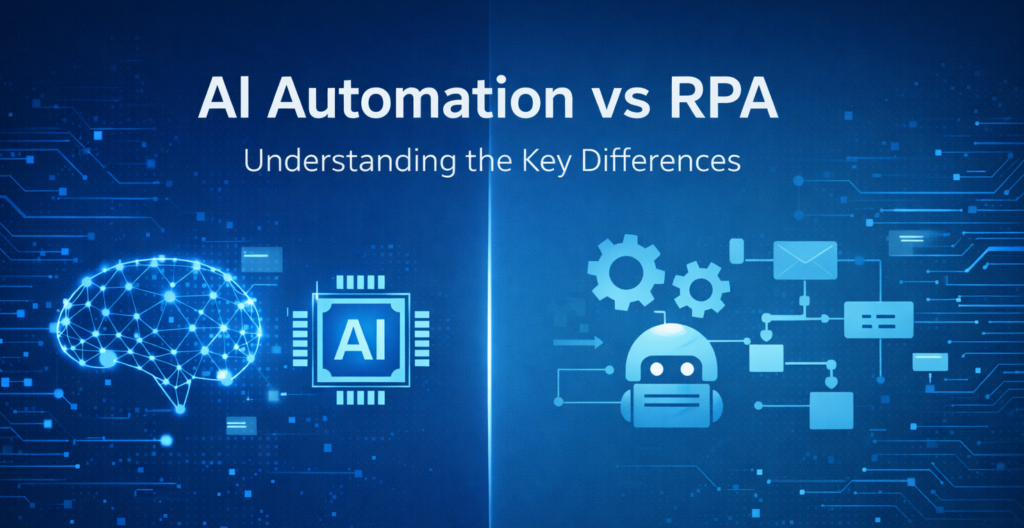
Although both AI Automation and Robotic Process Automation aim to improve efficiency and reduce manual work, they are fundamentally different in terms of how they operate and the types of processes they can automate. Understanding these differences is essential for organizations that want to implement the right automation strategy.
Decision-Making Capability
One of the most significant differences between AI Automation and RPA lies in their ability to make decisions. RPA operates strictly based on predefined rules. Bots follow a set of instructions programmed by developers and execute tasks exactly as instructed. If the input or workflow changes, the bot may fail or require reconfiguration. In other words, RPA does not “think” or interpret data; it simply follows rules.
AI Automation, on the other hand, is designed to support intelligent decision-making. By leveraging machine learning and data analytics, AI systems can analyze information, identify patterns, and generate insights. This allows them to make informed decisions or recommendations based on the data they process.
For example, while an RPA bot can automatically enter invoice data into an ERP system, an AI-powered system can analyze the invoice, detect anomalies, classify the document type, and determine whether the transaction requires further review.
Data Processing Capabilities
Another key distinction is the type of data each technology can handle. RPA works best with structured data that follows a consistent format, such as spreadsheets, databases, or standardized digital forms. Because the process logic is rule-based, RPA requires clearly defined inputs and predictable workflows.
AI Automation can process both structured and unstructured data. This includes emails, PDFs, images, voice recordings, and other forms of information that do not follow a fixed format. Technologies such as natural language processing and computer vision enable AI systems to interpret and analyze these complex data sources.
As a result, AI Automation is better suited for tasks that involve document understanding, customer interactions, or large-scale data analysis.
Learning and Adaptability
RPA systems do not learn from experience. Once deployed, they continue performing tasks according to the rules defined during implementation. If business processes change or exceptions occur frequently, developers must manually update the bot’s logic.
AI Automation systems are capable of continuous learning. Machine learning models improve their accuracy as they process more data and receive feedback. Over time, this allows the system to adapt to new patterns, detect unusual behaviors, and refine its predictions.
For example, in fraud detection, AI models can analyze transaction histories and identify suspicious activity based on evolving behavioral patterns. This adaptive capability makes AI Automation particularly valuable in dynamic business environments.
Complexity of Automated Tasks
RPA is most effective for simple, repetitive processes with clear rules. Typical examples include data entry, report generation, system reconciliation, or routine transaction processing.
AI Automation, by contrast, can support more complex workflows that require cognitive capabilities. These may include analyzing customer sentiment, forecasting demand, identifying operational risks, or optimizing business decisions based on predictive insights. In practice, this means RPA focuses primarily on task automation, while AI Automation enables intelligent process automation.
Scalability and Long-Term Value
Both technologies can improve operational efficiency, but their long-term impact may differ depending on the organization’s goals. RPA often delivers quick results because it can automate repetitive tasks with minimal system changes. Many companies adopt RPA as a first step in their automation journey to reduce manual workload and improve process speed.
AI Automation typically requires more advanced data infrastructure and model training, but it offers greater scalability and strategic value in the long term. By enabling data-driven insights and intelligent decision-making, AI-powered automation can transform entire business processes rather than simply automating individual tasks.
How to Choose Between AI Automation and RPA
Choosing between AI Automation and Robotic Process Automation requires a clear understanding of the business process you want to automate. Although both technologies aim to improve efficiency and reduce manual work, they are designed for different types of tasks. RPA focuses on automating structured, rule-based processes, while AI Automation enables systems to analyze data, recognize patterns, and support decision-making. For this reason, organizations should evaluate several key factors before deciding which approach is most suitable.
Evaluate Process Complexity
The first factor to consider is the complexity of the process. If the workflow follows a predictable sequence of steps and rarely changes, RPA is often the most practical solution. Processes such as data entry, invoice processing, payroll updates, or transferring information between systems typically follow predefined rules. In these scenarios, RPA bots can execute tasks quickly and accurately without requiring human intervention.
However, when a process involves interpretation, analysis, or decision-making, AI Automation becomes more appropriate. Tasks such as analyzing customer feedback, identifying fraud patterns, or predicting demand require the ability to evaluate data and respond to changing conditions. AI technologies are designed to handle these situations by learning from historical data and generating insights that guide automated actions.
Assess the Type of Data
Another important consideration is the type of data involved in the process. RPA performs best when working with structured data, such as spreadsheets, databases, or standardized forms where the format is consistent and predictable. In these cases, bots can easily extract and process information according to predefined rules.
AI Automation, in contrast, is capable of handling both structured and unstructured data. Technologies such as natural language processing and computer vision enable AI systems to interpret emails, documents, images, or other complex data formats. This capability allows organizations to automate processes that involve document understanding, customer communication, or large-scale data analysis.
Define Business Objectives
Business goals also play an important role in determining the right automation strategy. Organizations that want to reduce operational costs and automate repetitive administrative tasks often begin with RPA because it can deliver quick efficiency improvements with relatively low implementation complexity.
On the other hand, companies seeking to enhance decision-making, improve customer experiences, or generate insights from data may benefit more from AI Automation. By analyzing patterns and predicting outcomes, AI-driven systems can help businesses move beyond simple task automation and create more intelligent and adaptive workflows.
Consider Scalability and Long-Term Value
It is also important to think about the long-term scalability of the automation solution. RPA can quickly automate specific tasks, but its rule-based nature may limit flexibility when business processes change frequently. Maintaining large numbers of bots can require regular updates as systems evolve.
AI Automation offers greater long-term potential because it can learn from data and adapt to new situations. As organizations accumulate more information, AI systems can continuously improve their predictions and recommendations. This ability to evolve over time makes AI-driven automation particularly valuable for companies pursuing long-term digital transformation strategies.
Combine Both Technologies for Maximum Value
In many cases, the most effective approach is not choosing between AI Automation and RPA but combining both technologies. RPA can handle structured workflows and repetitive system interactions, while AI analyzes data, interprets information, and supports intelligent decision-making.
By integrating these capabilities, organizations can build intelligent automation systems that streamline operations while also unlocking deeper insights from data. This hybrid approach allows businesses to automate end-to-end processes more effectively and create a scalable foundation for future innovation.
Conclusion
AI Automation and Robotic Process Automation both play important roles in modern business automation, but they address different needs. RPA is ideal for automating repetitive, rule-based tasks that rely on structured data, helping organizations improve efficiency and reduce manual workload. In contrast, AI Automation enables systems to analyze data, recognize patterns, and support more intelligent decision-making in complex processes.
Rather than choosing one over the other, many organizations benefit from combining both technologies to build more advanced automation capabilities. With AI-driven solutions developed by Sphinx, enterprises can streamline workflows, unlock deeper insights from their data, and accelerate their digital transformation journey.



CEO - Son Le
기타 블로그
블로그
AI Chatbot Applications: Benefits, Use Cases, and Future Trends
Artificial Intelligence (AI) is rapidly transforming the way businesses communicate with customers, automate workflows, and deliver personalized experiences. At the center of this transformation is the AI chatbot, an intelligent virtual assistant capable of understanding natural language, answering questions, and supporting users across websites, mobile apps, and messaging platforms. As...
자세히 보기블로그
How AI Is Revolutionizing Hotel Operations and Revenue
The hospitality industry is undergoing one of its biggest transformations in decades. As guest expectations continue to rise and operational costs increase, hotels are turning to Artificial Intelligence (AI) to stay competitive. From maximizing room revenue to delivering personalized guest experiences, AI is no longer a futuristic concept. It has...
자세히 보기블로그
AI Chatbots in Hospitality: Drive Bookings & Better Service
The hospitality industry is rapidly embracing AI as guest expectations continue to evolve. Today’s travelers expect instant responses, personalized recommendations, and seamless communication throughout their booking journey. To meet these demands while improving operational efficiency, more hotels are turning to AI chatbots. Modern AI chatbots do far more than answer...
자세히 보기기타 블로그
서비스
IoT 개발
SphinX는 최첨단 IoT 개발 서비스를 제공하여 디바이스를 원활하게 연결하고 혁신적인 솔루션을 제공합니다.
테마서비스
블록체인 개발
우리는 신뢰할 수 있고 안전한 블록체인 기술을 처음부터 설계하는 데 매우 능숙하며, ...
테마서비스
ERP 및 CRM 개발
필요한 ERP & CRM 개발 서비스! 비즈니스 프로세스 간소화 및 조직 효율성 향상....
테마기타 블로그
서비스
IoT 개발
SphinX는 최첨단 IoT 개발 서비스를 제공하여 디바이스를 원활하게 연결하고 혁신적인 솔루션을 제공합니다.
테마서비스
블록체인 개발
우리는 신뢰할 수 있고 안전한 블록체인 기술을 처음부터 설계하는 데 매우 능숙하며, ...
테마서비스
ERP 및 CRM 개발
필요한 ERP & CRM 개발 서비스! 비즈니스 프로세스 간소화 및 조직 효율성 향상....
테마