


In the context of Blockchain technology being strongly deployed, Blockchain Trilemma is known as a special challenge that needs attention. When it comes to Blockchain Trilemma represents a balance between scalability, security, and decentralization features.
Software developers face these threefold challenges to optimally maintain strong security solutions and maintain well-considered decentralization.
We invite readers to join Sphinx to learn more about Blockchain Trilemma, and its impact on the Blockchain technology industry? as well as offer some comprehensive solutions to this challenge.
1. What is the Blockchain Trilemma?
Blockchain Trilemma is also known as The Blockchain Impossible Trinity since it covers all of blockchain technology’s limitations. Under normal conditions, Blockchain Technology is meant to meet the following goals: security, decentralization, and scalability. These three separate characteristics determine the blockchain network’s performance and dependability.
However, optimizing all three of these features simultaneously is challenging for blockchains. When one feature improves, another one suffers. As a result, it is referred to as the Blockchain Trilemma.
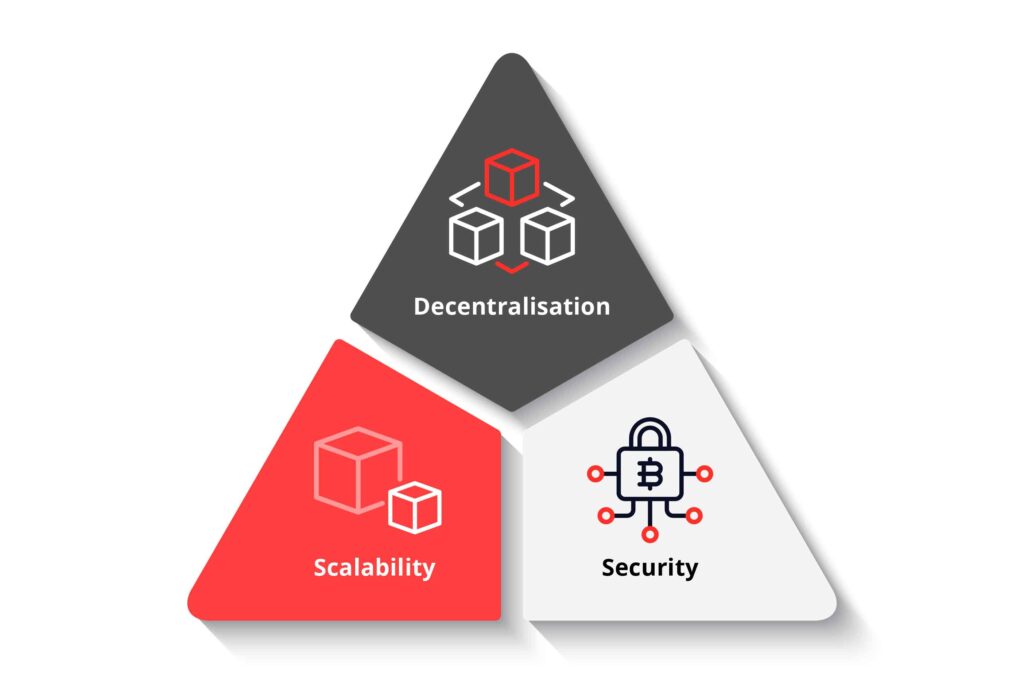
Decentralization: Let control and decision-making be distributed over a network of keys (computers) rather than being fixedly concentrated in the hands of a single authority is known as decentralization.
Security: Security assurance is crucial and significant for blockchain systems. This is because it entails implementing precautions to prevent unwanted access as well as fraudulent activity in cyberspace. As a result, public key cryptography, consensus techniques, and strong encryption are used by blockchain technology to accomplish this.
Scalability: The capacity of a system to handle growing transaction volumes without compromising network performance is referred to as scalability. This assumes even more significance when one considers that blockchain technology must cater to billions of users.
Scalability in blockchain can be difficult to achieve since decentralization and security are trade-offs by nature. Although security and decentralization are essential to maintaining integrity in blockchain systems, focusing on these elements may hinder scalability.
2. Why is Trilemma Blockchain still around and what effect does it have on Blockchain?
The delicate balance that must be struck between scalability, security, and decentralization is the core of the blockchain dilemma. It is quite difficult to attain ideal levels of all three of these attributes at the same time, and their interdependencies must be carefully taken into account.
According to the theory, fewer people could contribute to the network to increase speed and scalability. Nevertheless, this shift toward scalability could result in less decentralization and a concentration of power among a small number of players. In addition, as fewer people participate, the likelihood of an assault increases, potentially exposing the system to security vulnerabilities.
As a result, the Blockchain Trilemma has the characteristic that while one property rises, another attribute frequently declines.
3. Solutions to these challenges
3.1. Sharding
Sharding is a common Layer 1 scalability technique that comes from distributed database systems. The fundamental idea is “divide and conquer,” wherein shards of the blockchain system are created in smaller paragraphs. To reduce unnecessary strain on an individual central entity, each shard is allowed to handle a portion of all transactions.
3.2. The consensus mechanism is not the same
The Bitcoin network’s impossibility trinity challenge results from Proof of Work (PoW) security methods. PoW compromises speed for system security, but it does so by using encryption techniques, mining tools, and a large amount of decentralized computer power. Investigating other consensus techniques, like Ethereum’s switch from Proof of Work to Proof of Stake (PoS), is one way to solve the impossibility trinity.
3.3. Solutions for Layer 2
Layer 1 solutions include both replacement consensus techniques and sharding, and they are intended to change the network’s fundamental architecture. On top of already-existing network topologies, Layer 2 solutions are being investigated by several developers as a means of resolving the impossibility triangle.
Sidechains and state channels are two examples of off-chain transactions that help to lessen pressure and enhance performance. Sidechains are autonomous blockchains that are linked to the major chain, whereas state channels use smart contracts to transfer data from the entire network.
Conclusion
The Blockchain Trilemma’s intricate difficulties call for the clever and adaptable fusion of several techniques and systems. None of the three issues can be solved by a single strategy at once. Rather, to keep a balance between decentralization, security, and scalability, a sophisticated, inventive, and painstakingly designed system is required.



CEO - Son Le
OTHER BLOGS
Blogs
AI Chatbots in Hospitality: Drive Bookings & Better Service
The hospitality industry is rapidly embracing AI as guest expectations continue to evolve. Today’s travelers expect instant responses, personalized recommendations, and seamless communication throughout their booking journey. To meet these demands while improving operational efficiency, more hotels are turning to AI chatbots. Modern AI chatbots do far more than answer...
Read MoreBlogs
6 AI Trends Shaping the Future of Hotels in 2026
Artificial intelligence is no longer just a supporting technology for hotels. In 2026, AI is becoming a strategic business capability that helps hotels attract more direct bookings, improve operational efficiency, personalize guest experiences, and strengthen long-term competitiveness. Rather than replacing hospitality professionals, AI enables hotel teams to automate repetitive tasks...
Read MoreBlogs
AI Agents for Hotels: Key Benefits and Adoption Guide
The hospitality industry has always been driven by customer experience, operational efficiency, and the ability to respond quickly to changing guest expectations. However, rising operational costs, labor shortages, and increasing demand for personalized services are pushing hotels to rethink traditional approaches. This is where AI Agents for Hotels are becoming...
Read MoreOTHER BLOGS
Our Sevices
IoT Development
SphinX offers cutting-edge IoT development services, seamlessly connecting devices and providing innovative solutions for a...
Xem thêmOur Sevices
Blockchain Development
We are highly proficient in engineering reliable and secure blockchain technologies from the ground up,...
Xem thêmOur Sevices
ERP & CRM Development
ERP & CRM development services that you need! Streamline business processes and enhance organizational efficiency....
Xem thêmOTHER BLOGS
Our Sevices
IoT Development
SphinX offers cutting-edge IoT development services, seamlessly connecting devices and providing innovative solutions for a...
Xem thêmOur Sevices
Blockchain Development
We are highly proficient in engineering reliable and secure blockchain technologies from the ground up,...
Xem thêmOur Sevices
ERP & CRM Development
ERP & CRM development services that you need! Streamline business processes and enhance organizational efficiency....
Xem thêm