


Natural Language Processing is rapidly becoming a core driver of intelligent automation, enabling systems to understand, interpret, and respond to human language with increasing accuracy. As businesses continue to digitize operations and handle vast amounts of unstructured data, NLP bridges the gap between human communication and machine execution, making AI automation more flexible, scalable, and impactful across industries.
This blog explores how NLP works within AI automation, why it is essential for modern enterprises, and the key technologies and capabilities behind it. It also examines real-world applications and common challenges, helping organizations better understand how to leverage NLP to drive efficiency, improve decision-making, and enhance customer experiences.
What Is NLP in AI Automation?
Natural Language Processing is a branch of artificial intelligence that focuses on enabling machines to understand, interpret, and generate human language. In the context of AI automation, NLP allows systems to process unstructured text or speech data and turn it into actionable insights or automated responses.
Instead of relying on structured inputs like databases or predefined rules, NLP-powered systems can work with emails, chat messages, documents, voice commands, and more. This capability significantly expands the scope of automation across business functions.
How NLP Works in AI Automation
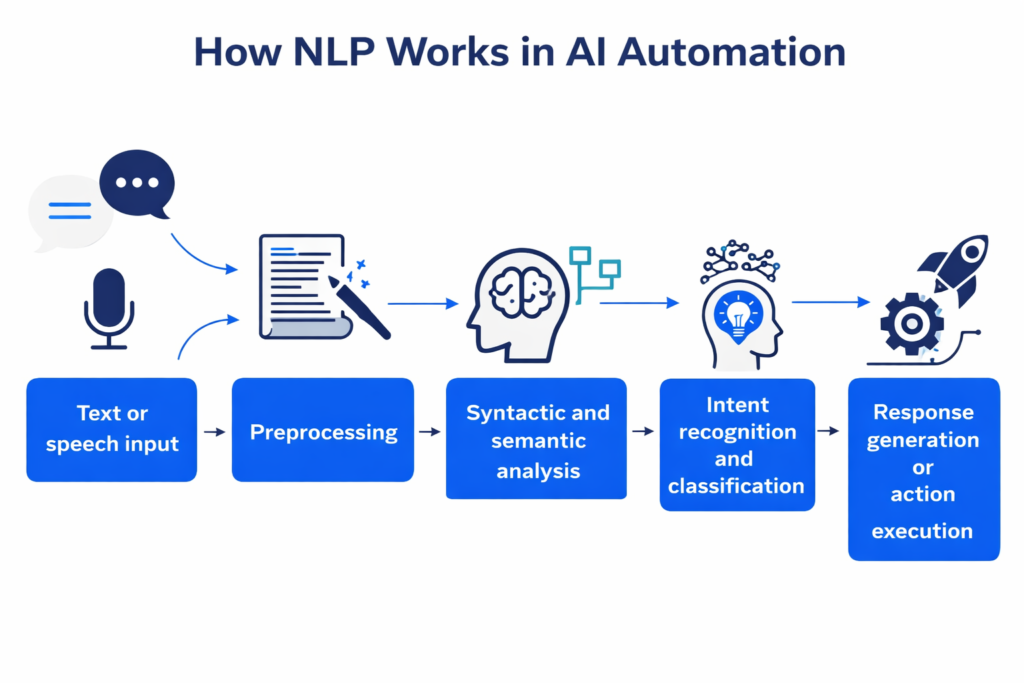
NLP in AI automation follows a structured 5-step process to transform human language into meaningful actions:
Text or speech input
The system receives input from users or data sources. This could be a chatbot message, a customer email, or a voice command.
Preprocessing
The input is cleaned and standardized. This includes tokenization, removing stop words, normalization, and sometimes stemming or lemmatization.
Syntactic and semantic analysis
The system analyzes sentence structure and meaning. Techniques such as part-of-speech tagging, named entity recognition, and dependency parsing are used to extract relevant information.
Intent recognition and classification
Machine learning models identify the user’s intent or classify the text into predefined categories.
Response generation or action execution
Based on the analysis, the system either generates a response, triggers a workflow, or updates a system.
Why NLP Matters in AI Automation
If traditional automation follows predefined rules, NLP enables systems to understand what those rules should be. It allows AI to process human language, turning unstructured inputs into actionable data and making automation more flexible, scalable, and intelligent.
Unlocking Unstructured Data
Most enterprise data exists in unstructured formats such as emails, chat messages, PDFs, and internal notes. Traditional automation systems struggle with this type of input because it lacks a fixed format.
NLP solves this problem by converting human language into structured data. It extracts key information such as entities, intent, and context, allowing workflows to move forward without manual intervention. This transforms previously unusable data into a valuable asset for automation.
Converting Language into Structured Workflows
A major advantage of NLP is its ability to transform free text into structured outputs. Instead of manually reviewing requests, systems can automatically identify what the issue is, who it relates to, and how urgent it is.
This structured understanding enables faster routing, fewer handoffs between teams, and more efficient workflow execution. As a result, organizations can reduce operational delays and improve overall productivity.
Handling Ambiguity and Context
Human language is inherently variable. Different users may describe the same problem in different ways, using different words or tones.
NLP allows automation systems to understand meaning beyond keywords. By analyzing context and intent, it ensures that similar requests are handled consistently, even when phrased differently. This makes automation more reliable and less dependent on rigid rules.
Improving Operational Efficiency
Manual tasks such as reading emails, categorizing tickets, extracting data, and reviewing documents consume significant time and resources.
With NLP, these processes can be automated with high accuracy. This reduces the workload on teams, minimizes human error, and allows employees to focus on higher-value tasks instead of repetitive work.
Scaling Decision-Making
As business operations grow, the volume of interactions and data increases rapidly. Maintaining consistency in decision-making becomes a challenge.
NLP enables systems to classify, prioritize, and route tasks based on meaning rather than simple metadata. This ensures that decisions remain consistent and efficient, even at scale.
Read more: 8 Benefits of AI Automation for Enterprise Success 2026
Core Technologies Behind NLP
NLP is built on a combination of linguistic principles and advanced machine learning techniques. The following technologies form the backbone of modern NLP systems:
Machine Learning and Deep Learning
Traditional NLP relied on rule-based systems, but modern approaches use machine learning models trained on large datasets. Deep learning models, especially neural networks, are now dominant in tasks like translation and sentiment analysis.
Transformer Models
Transformers have revolutionized NLP by enabling models to understand context more effectively. These models use attention mechanisms to process entire sequences of text simultaneously, improving accuracy and performance.
Word Embeddings
Word embeddings convert words into numerical vectors that capture semantic meaning. Techniques like Word2Vec and GloVe laid the foundation, while contextual embeddings from transformer models provide even richer representations.
Speech Recognition and Text-to-Speech
For voice-based automation, NLP integrates with speech technologies to convert spoken language into text and vice versa.
Natural Language Understanding and Generation
NLU focuses on comprehension, while NLG focuses on generating human-like text. Together, they enable conversational AI systems.
Key NLP Functions in AI Automation
NLP enables a range of core functions that allow AI systems to understand language and automate complex, language-driven workflows. These capabilities form the foundation of most enterprise NLP applications.
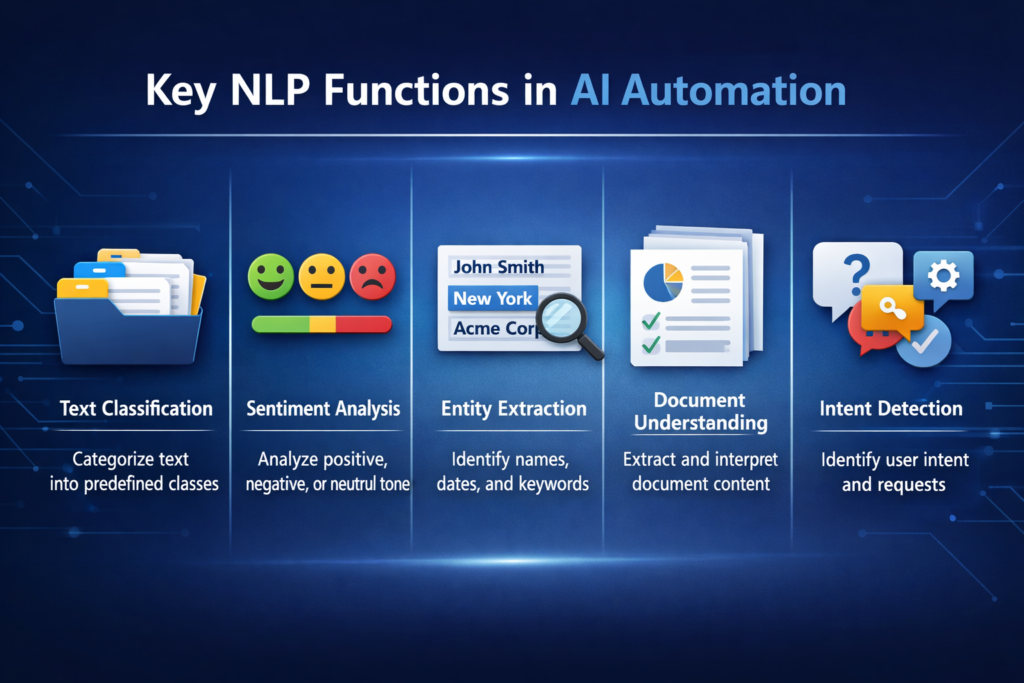
Text Classification
Text classification allows systems to automatically categorize content into predefined groups. This is widely used for tasks such as email routing, ticket tagging, and content moderation. By quickly organizing large volumes of text, it helps streamline workflows and reduce manual sorting.
Sentiment Analysis
Sentiment analysis determines the emotional tone behind a piece of text, such as positive, negative, or neutral. Businesses use this capability to monitor customer feedback, evaluate satisfaction, and identify potential issues early.
Entity Extraction
Also known as named entity recognition, this function identifies key elements within text, such as names, organizations, dates, locations, or product references. It helps convert unstructured language into structured data that can be used in automated processes.
Document Understanding
Document understanding goes beyond simple text extraction by interpreting the structure and meaning of entire documents. It enables systems to process invoices, contracts, and reports by identifying key fields, relationships, and context, supporting end-to-end automation.
Intent Detection
Intent detection identifies the purpose behind a user’s input. Whether a customer wants to make a complaint, request support, or ask for information, this capability allows systems to respond appropriately or trigger the correct workflow.
Real-World Applications of NLP in Automation
NLP is not just a theoretical capability. It is actively used across industries to automate complex, language-driven processes. By turning human language into structured data and actionable insights, NLP enables real business impact in day-to-day operations.
Customer Support Automation
NLP powers chatbots and virtual assistants that can understand customer queries and respond in real time. These systems can classify tickets, detect intent, and provide relevant answers without human intervention. As a result, businesses can reduce response times, lower support costs, and maintain 24/7 service availability.
Intelligent Document Processing
Enterprises handle large volumes of documents such as invoices, contracts, and reports. NLP enables systems to extract key information, understand document context, and automate workflows such as approvals or data entry. This reduces manual processing time and improves accuracy in document-heavy operations.
Email and Ticket Routing
NLP can automatically analyze incoming emails or support tickets, identify their purpose, and route them to the appropriate team. Instead of manual triaging, organizations can ensure faster response times and more efficient handling of requests.
Financial Analysis and Compliance
In finance, NLP is used to analyze reports, detect anomalies, and monitor regulatory compliance. It can extract relevant information from financial documents, identify risks, and support faster decision-making. This is particularly valuable in areas such as fraud detection and audit processes.
Healthcare Data Processing
Healthcare organizations use NLP to process clinical notes, patient records, and medical documents. It helps extract critical information, support diagnosis, and reduce administrative workload. This allows medical professionals to focus more on patient care.
Marketing and Customer Insights
NLP enables businesses to analyze customer feedback, social media conversations, and survey responses. By understanding sentiment and trends, companies can refine marketing strategies, improve products, and deliver more personalized experiences.
IT Operations and Helpdesk Automation
In IT environments, NLP is used to automate ticket classification, incident detection, and troubleshooting. Systems can understand user issues described in natural language and trigger appropriate responses or workflows, improving efficiency and system reliability.
Read more: Case study: S-visor
Challenges in Enterprise NLP Implementation
While NLP brings significant value to AI automation, implementing it at an enterprise level comes with several challenges. These issues often determine whether an NLP initiative delivers real impact or falls short.
Data Quality and Availability
NLP models depend heavily on large volumes of high-quality data. However, enterprise data is often fragmented, inconsistent, or poorly labeled. Without clean and well-structured datasets, model accuracy and reliability can drop significantly.
Handling Language Complexity
Human language is inherently complex, with ambiguity, context, slang, and domain-specific terminology. The same intent can be expressed in multiple ways, making it difficult for NLP systems to consistently interpret meaning without advanced modeling.
Domain Adaptation
Pretrained NLP models are typically trained on general data and may not perform well in specialized industries such as finance, healthcare, or legal. Enterprises often need to fine-tune models with domain-specific data, which requires time, expertise, and resources.
Integration with Enterprise Systems
Deploying NLP into existing workflows is not always straightforward. It must integrate with legacy systems, databases, and automation tools. Poor integration can limit the effectiveness of NLP and create operational bottlenecks.
Privacy, Security, and Compliance
NLP systems often process sensitive data, including customer information and internal documents. Ensuring data privacy, meeting regulatory requirements, and maintaining security standards are critical challenges, especially in highly regulated industries.
Read more: Challenges of AI Automation Every Business Should Know
Final Thoughts
NLP is a critical component that transforms AI automation from rule-based execution into intelligent, language-driven systems. By enabling machines to understand unstructured data, organizations can automate more complex workflows, improve efficiency, and deliver better user experiences.
To fully unlock its value, enterprises need the right data foundation, domain-specific optimization, and seamless integration into existing systems. When implemented effectively, NLP becomes a strategic capability that drives scalability and more consistent decision-making.
At Sphinx, our AI-powered BI solution S-Visor integrates NLP to help businesses convert unstructured data into actionable insights and smarter automation. This allows organizations to move faster, reduce manual effort, and build more intelligent, future-ready operations.



CEO - Son Le
OTHER BLOGS
Blogs
AI Chatbot Applications: Benefits, Use Cases, and Future Trends
Artificial Intelligence (AI) is rapidly transforming the way businesses communicate with customers, automate workflows, and deliver personalized experiences. At the center of this transformation is the AI chatbot, an intelligent virtual assistant capable of understanding natural language, answering questions, and supporting users across websites, mobile apps, and messaging platforms. As...
Read MoreBlogs
How AI Is Revolutionizing Hotel Operations and Revenue
The hospitality industry is undergoing one of its biggest transformations in decades. As guest expectations continue to rise and operational costs increase, hotels are turning to Artificial Intelligence (AI) to stay competitive. From maximizing room revenue to delivering personalized guest experiences, AI is no longer a futuristic concept. It has...
Read MoreBlogs
AI Chatbots in Hospitality: Drive Bookings & Better Service
The hospitality industry is rapidly embracing AI as guest expectations continue to evolve. Today’s travelers expect instant responses, personalized recommendations, and seamless communication throughout their booking journey. To meet these demands while improving operational efficiency, more hotels are turning to AI chatbots. Modern AI chatbots do far more than answer...
Read MoreOTHER BLOGS
Our Sevices
IoT Development
SphinX offers cutting-edge IoT development services, seamlessly connecting devices and providing innovative solutions for a...
Xem thêmOur Sevices
Blockchain Development
We are highly proficient in engineering reliable and secure blockchain technologies from the ground up,...
Xem thêmOur Sevices
ERP & CRM Development
ERP & CRM development services that you need! Streamline business processes and enhance organizational efficiency....
Xem thêmOTHER BLOGS
Our Sevices
IoT Development
SphinX offers cutting-edge IoT development services, seamlessly connecting devices and providing innovative solutions for a...
Xem thêmOur Sevices
Blockchain Development
We are highly proficient in engineering reliable and secure blockchain technologies from the ground up,...
Xem thêmOur Sevices
ERP & CRM Development
ERP & CRM development services that you need! Streamline business processes and enhance organizational efficiency....
Xem thêm