



Artificial intelligence is no longer a future trend reserved for large tech companies. Today, businesses across industries are using AI to automate operations, improve customer experiences, optimize decision-making, and drive growth. However, successful adoption requires more than simply purchasing AI tools. Companies need a clear AI implementation roadmap to align technology with business goals and ensure long-term success.
In this blog, we’ll explore what an AI implementation roadmap is, why enterprises need one, the essential elements it should include, and the best practices for deploying AI effectively.
What Is an AI Implementation Roadmap?
An AI implementation roadmap is a structured plan that outlines how an organization will adopt, integrate, and scale artificial intelligence technologies within its operations. It provides a strategic framework that helps businesses move from initial AI exploration to full deployment and optimization.
A well-designed roadmap typically includes:
- Business objectives and expected outcomes
- AI use cases and priorities
- Data infrastructure requirements
- Technology stack selection
- Resource allocation
- Risk management and compliance considerations
- Deployment timelines and success metrics
Rather than implementing AI randomly across departments, the roadmap ensures every initiative supports broader business goals and delivers measurable value.
Why a Strategic AI Roadmap Matters for Enterprises
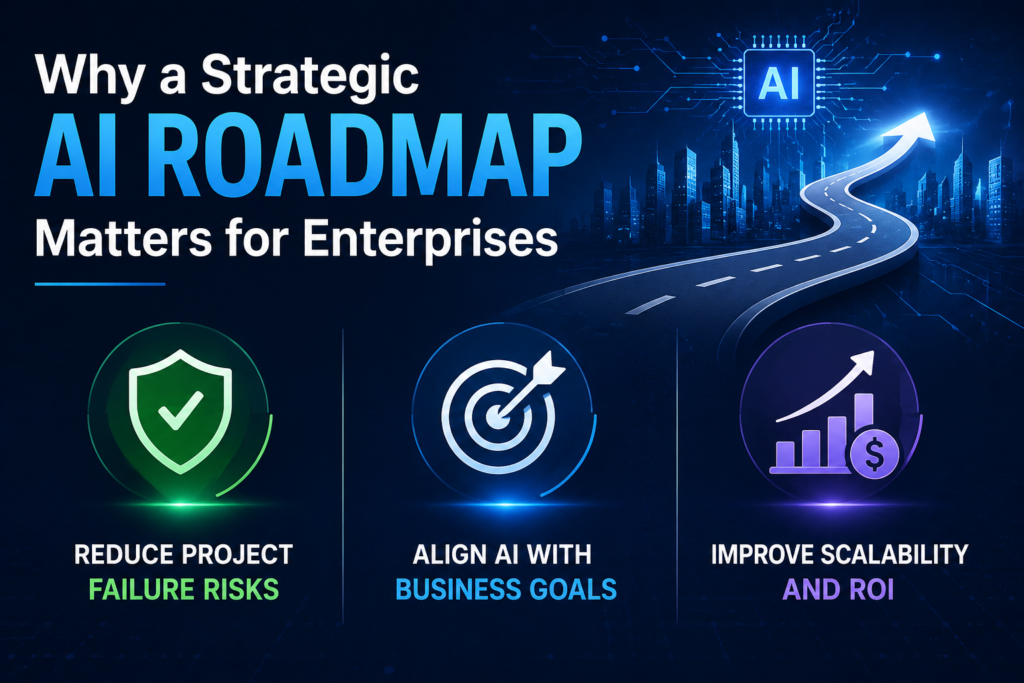
A well-structured AI roadmap helps businesses move beyond experimentation and implement AI with clear direction, measurable outcomes, and long-term scalability. Instead of deploying disconnected AI tools, organizations can build a strategy that supports sustainable growth and operational success.
Minimize AI Deployment and Execution Risks
Many AI projects fail because of poor planning, unclear objectives, low-quality data, or lack of internal alignment. A strategic roadmap helps businesses identify potential obstacles early in the process, reducing implementation delays, budget overruns, and integration issues.
This approach allows organizations to evaluate technical readiness before deployment, identify infrastructure and data gaps, establish realistic timelines, and reduce operational disruption during implementation. As a result, businesses can improve project success rates and create a smoother AI adoption process.
Ensure AI Initiatives Support Core Business Objectives
AI should deliver measurable business value rather than being adopted simply for innovation purposes. A roadmap helps organizations connect AI initiatives directly to strategic goals such as improving efficiency, enhancing customer experience, increasing revenue, or reducing operational costs.
When AI strategies are aligned with business priorities, companies can focus on high-impact use cases, allocate resources more effectively, improve collaboration across departments, and establish clearer performance benchmarks. This alignment ensures AI investments contribute directly to long-term business growth.
Build a Scalable AI Strategy with Stronger ROI Potential
AI adoption is not a one-time implementation but a long-term transformation process. A roadmap helps organizations build scalable infrastructure, flexible workflows, and sustainable AI strategies that can evolve alongside business growth and changing market demands.
A scalable AI strategy supports continuous optimization, wider adoption across departments, and improved operational efficiency over time. With clearly defined KPIs and performance tracking, businesses can also measure ROI more accurately and continuously refine AI initiatives for stronger long-term results.
Step-by-Step AI Implementation Roadmap for Enterprises
A structured AI implementation approach is essential for turning strategy into real-world execution. Instead of deploying AI in an uncoordinated way, enterprises should follow a clear sequence of steps to ensure successful adoption, scalability, and measurable impact.
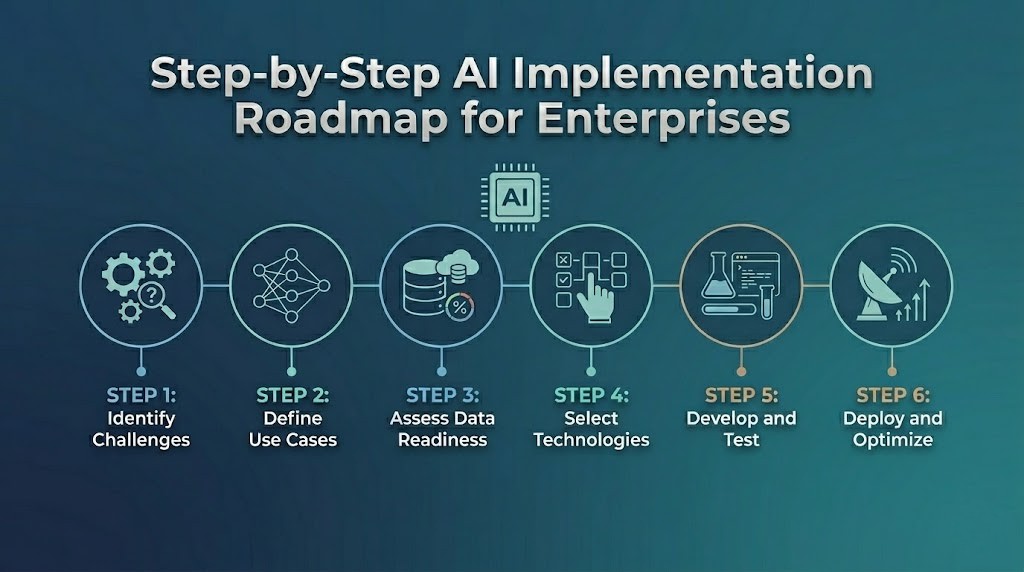
Below is a practical 6-step AI implementation roadmap for businesses:
Step 1: Identify Business Challenges and Opportunities
The first step is to analyze current business operations and identify areas where AI can create meaningful value. Focus on high impact problems such as operational inefficiencies, customer experience gaps, or slow decision making processes.
The goal is to prioritize real business problems, not just technology trends.
Step 2: Define Clear AI Use Cases
Once challenges are identified, translate them into specific AI use cases. This could include automation, prediction models, intelligent chat systems, or data driven insights.
Selecting the right use cases ensures AI initiatives are focused, measurable, and aligned with business needs.
Step 3: Assess Data Readiness and Infrastructure
AI performance depends heavily on data quality and system readiness. At this stage, businesses should evaluate:
- Data availability and accuracy
- Data storage and governance
- System integration capabilities
- Cloud or on premise infrastructure readiness
This step ensures the foundation is strong before building AI solutions.
Step 4: Select the Right AI Technologies and Tools
Choose AI frameworks, platforms, and tools that match business requirements. Consider factors such as scalability, cost, compatibility, and long term flexibility.
The right technology stack ensures smooth development and future expansion.
Step 5: Develop and Test AI Solutions
Before full deployment, businesses should build pilot projects or proof of concept models. This allows teams to test performance, identify risks, and refine algorithms based on real data.
Testing helps reduce failure risks and improves overall solution quality.
Step 6: Deploy Monitor and Continuously Optimize
After validation, AI solutions are deployed into real business environments. However, implementation does not end here.
Organizations must continuously monitor performance, track KPIs, retrain models, and optimize workflows to ensure long term effectiveness and ROI.
Key Challenges in Implementing an AI Roadmap
Implementing an AI roadmap can deliver significant business value, but organizations often face several critical challenges during the journey. Understanding these obstacles early helps businesses prepare better and increase the success rate of AI initiatives.
Data Quality and Accessibility Issues
AI systems depend heavily on high quality and well structured data. Many enterprises struggle with fragmented data sources, inconsistent formats, or incomplete datasets. In some cases, data is stored in silos across different departments, making it difficult to integrate and use effectively.
Without reliable data, AI models may produce inaccurate or biased results, reducing overall effectiveness.
Data Quality and Accessibility Issues
AI systems depend heavily on high quality and well structured data. Many enterprises struggle with fragmented data sources, inconsistent formats, or incomplete datasets. In some cases, data is stored in silos across different departments, making it difficult to integrate and use effectively.
Without reliable data, AI models may produce inaccurate or biased results, reducing overall effectiveness.
Shortage of Skilled Talent and Expertise
Successful AI implementation requires specialized skills in data science, machine learning, engineering, and AI operations. However, many companies face a shortage of experienced professionals in these areas.
This talent gap can slow down development, increase reliance on external vendors, and limit the organization’s ability to scale AI solutions internally.
Integration and Scalability Challenges
Integrating AI systems into existing infrastructure is often complex. Legacy systems may not support modern AI technologies, leading to compatibility issues and operational disruptions.
In addition, scaling AI from pilot projects to enterprise wide deployment requires strong architecture, governance, and continuous optimization. Without proper planning, AI solutions may remain stuck at the experimental stage.
Best Practices for AI Implementation
Successful AI adoption is not only about choosing the right technology but also about applying the right execution approach. Organizations need clear principles to guide implementation, ensure smooth adoption, and maximize long term value. Below are four key best practices that help businesses deploy AI effectively and sustainably.
Start Small and Prove Value: Begin with a focused pilot project to demonstrate clear business impact before scaling AI across the organization.
Promote Cross Functional Collaboration: Combine IT, business teams, and end users to ensure AI solutions are practical and aligned with real needs.
Prioritize AI Governance: Establish clear rules for data use, compliance, and model transparency to ensure safe and responsible AI deployment.
Invest in Training and Enablement: Equip employees with the skills to use AI effectively so adoption is smooth and productivity driven.
How to Select the Right AI Implementation Partner
Choosing the right AI partner is a critical decision that directly impacts the success, speed, and scalability of your AI initiatives. A strong partner can help reduce risks, accelerate development, and ensure your solutions deliver real business value.
Evaluate Industry Experience and Domain Knowledge
Select a partner with proven experience in your industry and a clear understanding of your business challenges. Domain expertise ensures faster implementation and more relevant AI solutions.
Assess Technical Capabilities and AI Expertise
Ensure the partner has strong skills in machine learning, data engineering, system integration, and scalable AI architecture. Their technical depth determines the quality and reliability of the final solution.
Check Scalability and Long Term Support
AI is not a one time project. Choose a partner who can support long term growth, system upgrades, and continuous optimization as your business evolves.
Review Communication and Delivery Transparency
A reliable partner should provide clear timelines, transparent processes, and consistent communication. This helps avoid misunderstandings and keeps projects on track.#
Read more: AI in Workflow Automation: Smarter Business Processes
Final Thoughts
AI implementation is no longer just an innovation trend but a core part of modern digital transformation. As discussed throughout this blog, a successful AI journey requires a clear roadmap, strong strategic alignment, well prepared data infrastructure, and continuous optimization. Without a structured approach, businesses risk fragmented initiatives and limited long term value.
If you are looking for an AI company to help you design and execute a scalable, business driven AI strategy, Sphinx JSC can be a reliable partner. With expertise in AI development, system integration, and enterprise solutions, Sphinx JSC supports organizations in turning AI ideas into practical, high impact applications that deliver measurable results and sustainable growth.



CEO - Son Le
OTHER BLOGS
Blogs
AI Chatbot Applications: Benefits, Use Cases, and Future Trends
Artificial Intelligence (AI) is rapidly transforming the way businesses communicate with customers, automate workflows, and deliver personalized experiences. At the center of this transformation is the AI chatbot, an intelligent virtual assistant capable of understanding natural language, answering questions, and supporting users across websites, mobile apps, and messaging platforms. As...
Read MoreBlogs
How AI Is Revolutionizing Hotel Operations and Revenue
The hospitality industry is undergoing one of its biggest transformations in decades. As guest expectations continue to rise and operational costs increase, hotels are turning to Artificial Intelligence (AI) to stay competitive. From maximizing room revenue to delivering personalized guest experiences, AI is no longer a futuristic concept. It has...
Read MoreBlogs
AI Chatbots in Hospitality: Drive Bookings & Better Service
The hospitality industry is rapidly embracing AI as guest expectations continue to evolve. Today’s travelers expect instant responses, personalized recommendations, and seamless communication throughout their booking journey. To meet these demands while improving operational efficiency, more hotels are turning to AI chatbots. Modern AI chatbots do far more than answer...
Read MoreOTHER BLOGS
Our Sevices
IoT Development
SphinX offers cutting-edge IoT development services, seamlessly connecting devices and providing innovative solutions for a...
Xem thêmOur Sevices
Blockchain Development
We are highly proficient in engineering reliable and secure blockchain technologies from the ground up,...
Xem thêmOur Sevices
ERP & CRM Development
ERP & CRM development services that you need! Streamline business processes and enhance organizational efficiency....
Xem thêmOTHER BLOGS
Our Sevices
IoT Development
SphinX offers cutting-edge IoT development services, seamlessly connecting devices and providing innovative solutions for a...
Xem thêmOur Sevices
Blockchain Development
We are highly proficient in engineering reliable and secure blockchain technologies from the ground up,...
Xem thêmOur Sevices
ERP & CRM Development
ERP & CRM development services that you need! Streamline business processes and enhance organizational efficiency....
Xem thêm