


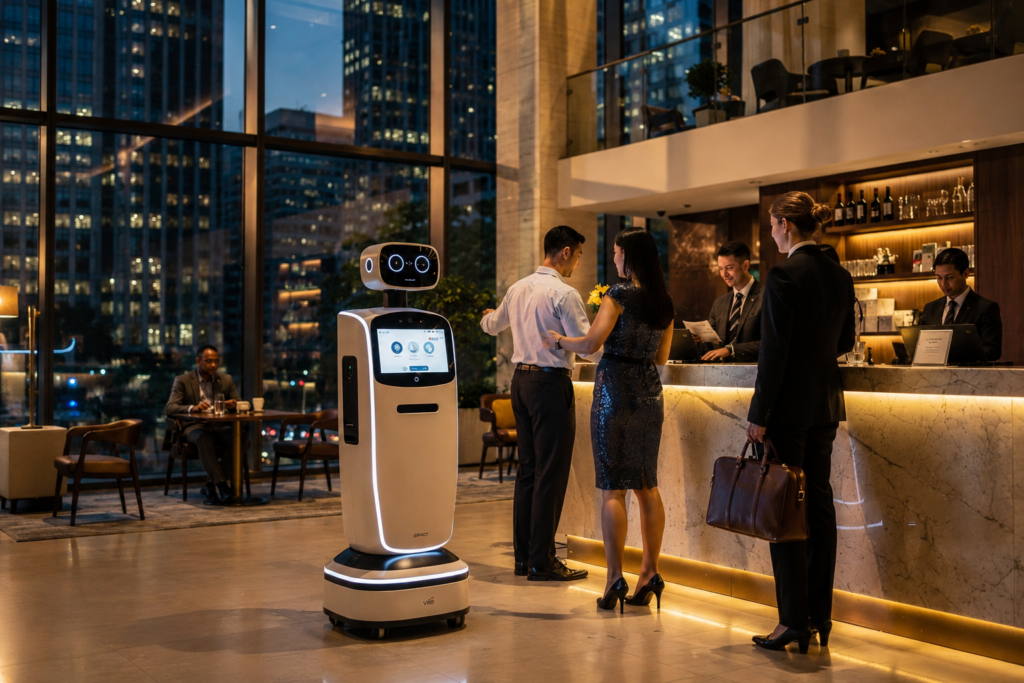
The hospitality industry has always been driven by customer experience, operational efficiency, and the ability to respond quickly to changing guest expectations. However, rising operational costs, labor shortages, and increasing demand for personalized services are pushing hotels to rethink traditional approaches.
This is where AI Agents for Hotels are becoming a strategic technology solution. Unlike traditional automation tools that only follow predefined rules, AI agents can analyze information, make decisions, complete tasks, and continuously improve based on data.
From handling guest requests and optimizing pricing strategies to supporting hotel teams with daily operations, AI agents are transforming how hotels deliver services and manage resources.
This guide explores what AI agents are, why hotels are adopting them, their business impact, practical use cases, challenges, and how hospitality businesses can successfully implement AI-powered solutions.
What Are AI Agents for Hotels?
AI Agents for Hotels are intelligent software systems designed to perform tasks, make decisions, and interact with guests, employees, and hotel systems with minimal human intervention.
Unlike basic chatbots that respond based on fixed scripts, AI agents use technologies such as machine learning, natural language processing, and large language models to understand context, analyze data, and take actions.
Why Hotels Are Turning to AI Agents: Key Drivers Behind Adoption
Hotels are increasingly adopting AI Agents for Hotels to improve guest experiences, streamline operations, and adapt to the fast-changing hospitality landscape. Several technology, customer, and business factors are accelerating AI adoption across the industry.
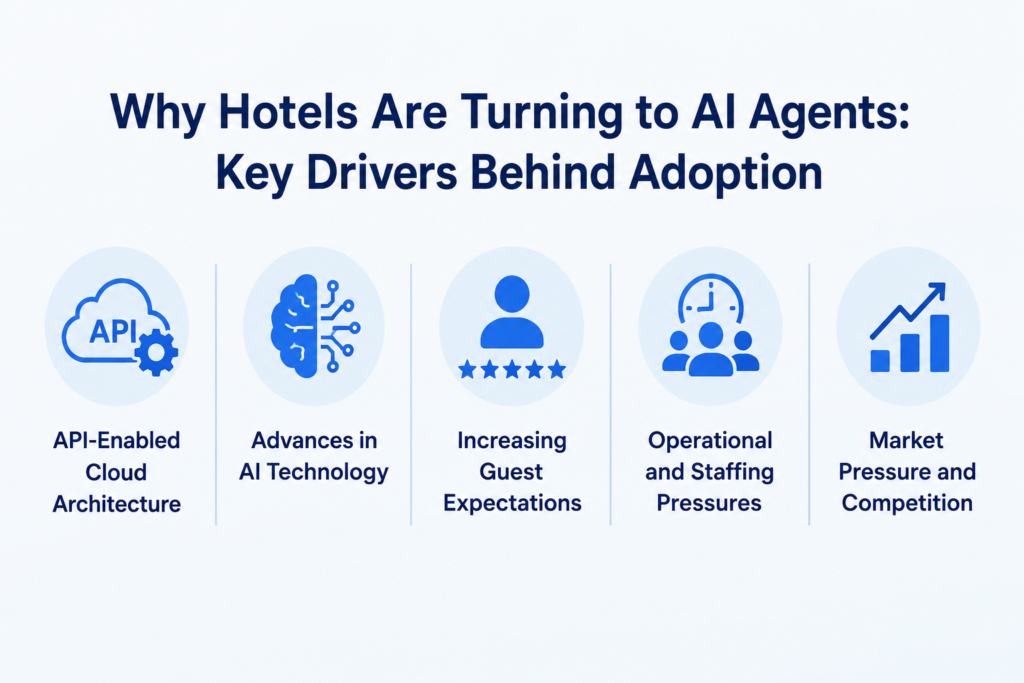
API-Enabled Cloud Architecture
The growth of API-enabled cloud architecture has made it easier for hotels to connect AI agents with existing technology systems such as property management systems (PMS), customer relationship management platforms (CRM), booking engines, and operational tools.
This connected infrastructure allows AI agents to access real-time information, automate workflows, and support better decision-making. Hotels can use AI agents to manage guest requests, update information, coordinate tasks between departments, and create more seamless service experiences.
Cloud-based systems also make AI adoption more flexible and scalable, allowing hotels to integrate new capabilities without major changes to their existing technology infrastructure.
Advances in AI Technology
Rapid improvements in artificial intelligence have expanded the capabilities of AI agents beyond traditional automation.
Modern AI agents can understand natural language, analyze data, learn from interactions, and complete more complex tasks. This enables hotels to provide more intelligent guest support, improve internal operations, and deliver personalized services at scale.
As AI technology continues to evolve, hotels are gaining access to more powerful solutions that can support both customer-facing and operational processes.
Increasing Guest Expectations
Today’s travelers expect faster, more convenient, and personalized experiences throughout their hotel journey. Guests want immediate responses, smooth digital interactions, and services that match their individual preferences.
AI agents help hotels meet these expectations by providing 24/7 assistance, answering guest questions, supporting bookings, and delivering personalized recommendations. This allows hotels to improve guest satisfaction while maintaining consistent service quality.
Operational and Staffing Pressures
Hotels are facing growing challenges related to labor shortages, rising costs, and increasing operational demands. Employees often spend significant time handling repetitive tasks, which can reduce their ability to focus on higher-value guest interactions.
AI agents help address these challenges by automating routine processes and supporting hotel teams with faster access to information. By reducing manual workload, AI allows employees to focus on delivering better service and improving the overall guest experience.
Market Pressure and Competition
Competition in the hospitality industry continues to increase as hotels look for new ways to attract guests and improve efficiency.
AI agents provide hotels with opportunities to differentiate through faster service, personalized experiences, and smarter operations. As more businesses adopt AI-driven solutions, hotels that embrace this technology can strengthen their competitive position and better respond to changing market demands.
The Current Landscape of AI Adoption Across the Hotel Industry
AI adoption in the hospitality industry is moving from early experimentation toward broader implementation. Hotels are increasingly exploring artificial intelligence to improve guest interactions, optimize operations, and support business decision-making. However, while AI usage is growing rapidly, many hotel organizations are still developing a clear strategy for long-term adoption.
According to research from H2C, AI has already become part of the technology landscape for many hotel businesses, with 78% of hotel chains currently using AI solutions. The momentum is expected to continue, as 89% of hotels plan to increase their investment and expand AI applications over the next two years.
Despite this strong interest, many hotels are still in the early stages of building a structured AI roadmap. Only 6% of hotel chains have established an organization-wide AI strategy, showing that adoption is often happening through individual projects rather than a fully integrated approach.
Today, hotels are mainly applying AI in areas where it can create immediate value, such as guest communication, customer support, revenue management, marketing personalization, and operational automation. AI-powered tools are helping hotels respond faster to guest needs, analyze large amounts of data, and improve efficiency across departments.
9 AI Agents Reshaping the Future of Hospitality
AI agents are becoming increasingly valuable across different areas of hotel operations, helping businesses improve efficiency, enhance guest experiences, and optimize revenue opportunities. From managing pricing strategies to supporting daily operations, these intelligent systems are transforming how hotels operate and interact with guests.
Below are nine types of AI agents that are driving the future of hospitality.
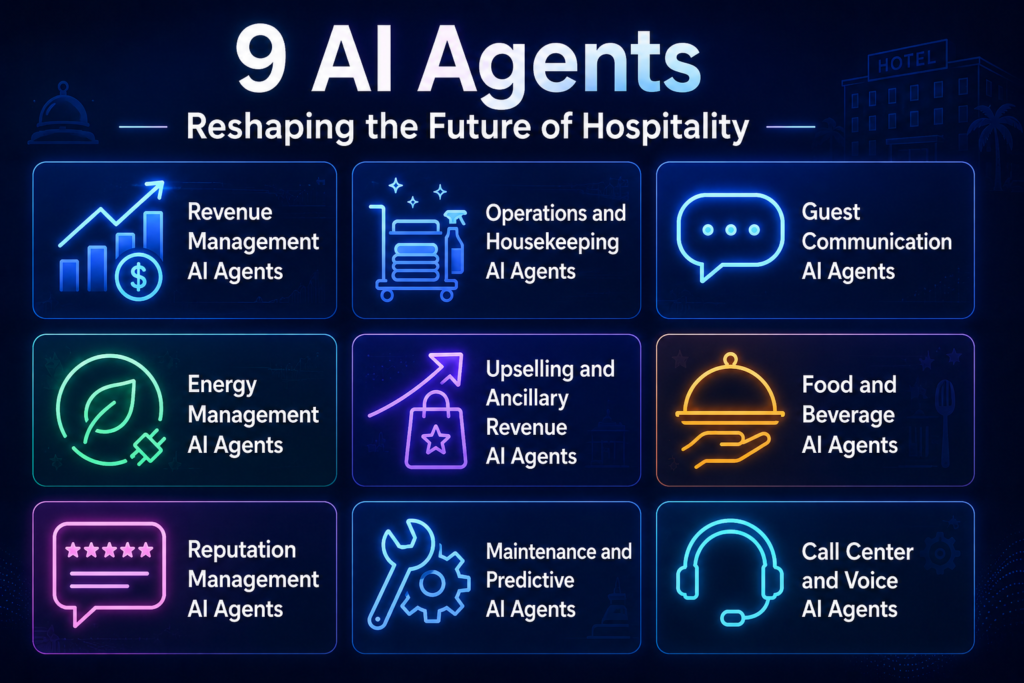
Revenue Management AI Agents
Revenue management AI agents help hotels make smarter pricing and inventory decisions by analyzing market demand, booking trends, competitor activity, and historical performance.
These AI agents can identify pricing opportunities, forecast demand, and recommend rate adjustments to maximize occupancy and revenue. By processing large amounts of data in real time, they help revenue teams make faster and more accurate decisions.
Operations and Housekeeping AI Agents
Operations and housekeeping AI agents support hotel teams by improving task coordination and workflow management.
They can help prioritize housekeeping schedules, manage room readiness updates, and improve communication between departments such as front desk, housekeeping, and maintenance. This allows hotels to reduce delays, improve efficiency, and provide a smoother guest experience.
Guest Communication AI Agents
Guest communication AI agents focus on improving interactions throughout the guest journey, from pre-arrival questions to post-stay support.
These AI agents can handle common requests, provide hotel information, assist with reservations, and respond to guest inquiries across multiple channels such as websites, mobile apps, and messaging platforms.
By providing 24/7 assistance, they help hotels deliver faster and more consistent communication.
Energy Management AI Agents
Energy management AI agents help hotels optimize energy usage and reduce operational costs.
By analyzing data from smart devices, building systems, and occupancy patterns, these AI agents can identify opportunities to improve energy efficiency. Hotels can use them to optimize heating, cooling, lighting, and other energy-consuming systems while supporting sustainability goals.
Upselling and Ancillary Revenue AI Agents
Upselling and ancillary revenue AI agents help hotels generate additional revenue by identifying personalized opportunities for guests.
These AI agents analyze guest preferences, booking details, and behavior patterns to recommend relevant services such as room upgrades, dining options, transportation, or additional experiences.
Instead of offering generic promotions, AI agents enable hotels to deliver more targeted and timely recommendations.
Food and Beverage AI Agents
Food and beverage AI agents support hotel restaurants, bars, and dining services by improving guest engagement and operational efficiency.
They can assist with menu recommendations, reservation management, demand forecasting, and personalized dining suggestions. These solutions help hotels enhance the food and beverage experience while improving resource planning.
Reputation Management AI Agents
Reputation management AI agents help hotels monitor and improve their online reputation by analyzing guest reviews, feedback, and customer sentiment.
These AI agents can identify common service issues, track guest satisfaction trends, and provide insights that help hotels improve service quality.
By understanding guest feedback more effectively, hotels can respond faster and make data-driven improvements.
Maintenance and Predictive AI Agents
Maintenance and predictive AI agents help hotels identify potential equipment issues before they become major problems.
By analyzing data from hotel systems and connected devices, these AI agents can predict maintenance needs, prioritize repair tasks, and reduce unexpected downtime.
This proactive approach helps hotels maintain better facilities while controlling maintenance costs.
Call Center and Voice AI Agents
Call center and voice AI agents improve how hotels manage phone-based guest interactions.
These AI agents can handle reservation inquiries, answer frequently asked questions, and support guests through voice conversations. They help reduce pressure on call center teams while ensuring guests receive quick and consistent assistance.
As voice technology continues to improve, these AI agents are becoming an important part of creating seamless and accessible hotel communication experiences.
As AI technology continues to mature, the hospitality industry is expected to shift from using separate AI tools toward more connected AI ecosystems, where AI agents can support multiple functions and work alongside hotel teams to deliver smarter, more personalized experiences.
How AI Agents Are Transforming Different Hotel Business Models
The value of AI Agents for Hotels depends on the size and operational structure of each property. Independent hotels and large hotel groups use AI agents in different ways to improve efficiency, guest experience, and business performance.
AI Agents for Independent and Boutique Hotels
For independent hotels and boutique properties, AI agents help small teams improve service quality while reducing manual workload.
They can automate guest communication, handle common requests, support bookings, and provide personalized recommendations without requiring additional staff. This allows smaller hotels to offer faster and more consistent service while maintaining a personal guest experience.
AI agents also help independent hotels compete more effectively by improving operational efficiency and creating more opportunities for upselling and guest engagement.
AI Agents for Hotel Groups and Multi-Property Brands
For hotel chains and multi-property groups, AI agents support scalability, operational consistency, and data-driven decision-making.
They can connect information across multiple properties, optimize workflows, improve customer support, and provide insights from large amounts of guest and operational data.
By integrating AI agents into different departments, hotel groups can deliver more consistent experiences while improving efficiency across their entire portfolio.
Common Challenges When Deploying AI Agents in Hotels
While AI Agents for Hotels bring significant benefits, hotels need to overcome several challenges during implementation:
- Data Quality and Integration: Ensuring accurate data and smooth connections between AI agents and existing hotel systems such as PMS, CRM, and booking platforms.
- Employee Adoption and Training: Helping hotel teams understand, trust, and effectively use AI tools in daily operations.
- Data Privacy and Security: Protecting guest information and ensuring AI solutions meet privacy and compliance requirements.
- Selecting the Right AI Solution: Choosing AI agents that align with business objectives, operational needs, and existing technology infrastructure.
- Measuring ROI and Success: Tracking performance through key metrics such as efficiency improvements, cost savings, and guest satisfaction.
How to Apply Artificial Intelligence in Hospitality
Successfully implementing artificial intelligence in hospitality requires more than simply adopting new technology. Hotels need a clear strategy that connects AI solutions with real business goals, operational needs, and guest expectations.
By applying AI across different areas of the hotel ecosystem, businesses can improve efficiency, create more personalized experiences, and make better data-driven decisions.
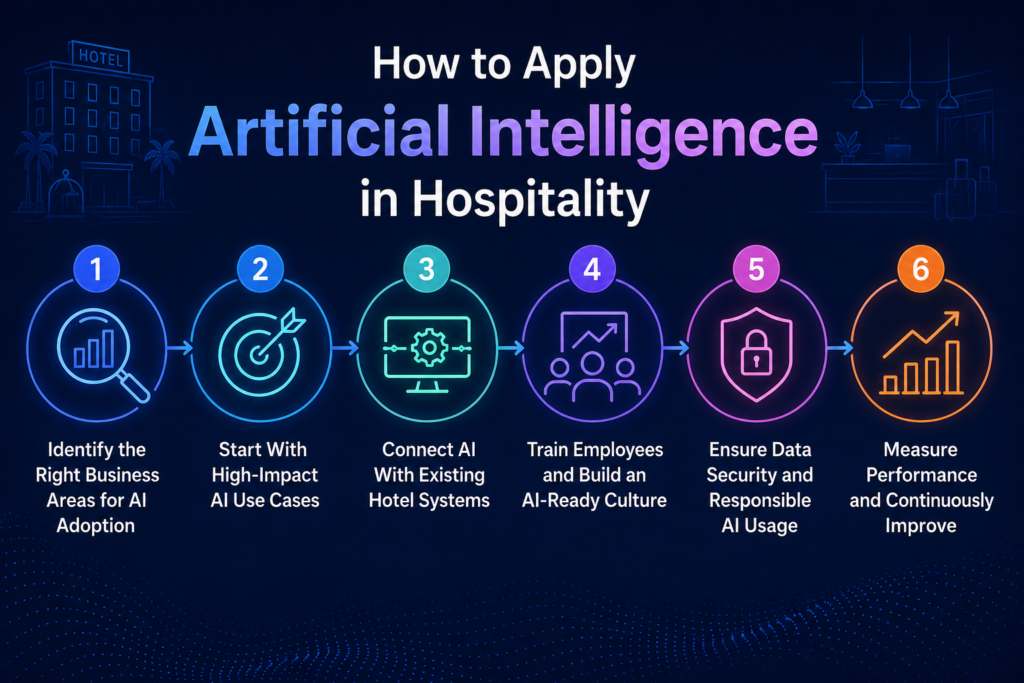
Identify the Right Business Areas for AI Adoption
Hotels should begin by identifying operational challenges where AI can create measurable value.
Common areas where AI can support include guest communication, revenue optimization, marketing, customer service, housekeeping, maintenance, and internal operations.
Instead of applying AI everywhere at once, hotels should prioritize processes that involve high workloads, repetitive tasks, or opportunities for improving guest satisfaction.
Start With High-Impact AI Use Cases
Hotels should focus on AI applications that can deliver visible results quickly.
For example, guest communication AI agents can reduce response times by handling frequently asked questions and service requests. Revenue management AI agents can help optimize pricing decisions by analyzing demand patterns and market conditions.
Starting with practical use cases allows hotels to measure results and build confidence before expanding AI adoption.
Connect AI With Existing Hotel Systems
AI solutions become more effective when they are integrated with existing hotel technology.
By connecting AI agents with systems such as Property Management Systems (PMS), Customer Relationship Management platforms (CRM), booking engines, and communication channels, hotels can provide more accurate and personalized services.
For example, an AI agent connected to a PMS can access reservation details, understand guest preferences, and support personalized recommendations throughout the guest journey.
Train Employees and Build an AI-Ready Culture
Successful AI adoption depends on how well employees understand and use the technology.
Hotels should provide training to help staff learn how AI tools work, how they can support daily tasks, and how employees can combine AI capabilities with human hospitality skills.
The goal is not to replace hotel teams but to help employees work more efficiently and focus on higher-value guest interactions.
Ensure Data Security and Responsible AI Usage
Hotels handle large amounts of guest information, making data protection an important part of AI implementation.
Businesses need to establish clear policies around data management, privacy protection, and system security. Choosing reliable AI solutions and maintaining proper governance helps hotels build trust with both guests and employees.
Measure Performance and Continuously Improve
AI implementation should be monitored through clear performance indicators.
Hotels can evaluate AI effectiveness by tracking metrics such as response time, operational efficiency, guest satisfaction scores, booking conversion rates, and additional revenue generated.
Continuous analysis allows hotels to improve AI workflows, expand successful applications, and maximize long-term value from their investment.
By following a structured approach, hotels can move beyond AI experimentation and create practical AI-driven operations that enhance both guest experiences and business performance.



CEO - Son Le
OTHER BLOGS
Blogs
AI Chatbot Applications: Benefits, Use Cases, and Future Trends
Artificial Intelligence (AI) is rapidly transforming the way businesses communicate with customers, automate workflows, and deliver personalized experiences. At the center of this transformation is the AI chatbot, an intelligent virtual assistant capable of understanding natural language, answering questions, and supporting users across websites, mobile apps, and messaging platforms. As...
Read MoreBlogs
How AI Is Revolutionizing Hotel Operations and Revenue
The hospitality industry is undergoing one of its biggest transformations in decades. As guest expectations continue to rise and operational costs increase, hotels are turning to Artificial Intelligence (AI) to stay competitive. From maximizing room revenue to delivering personalized guest experiences, AI is no longer a futuristic concept. It has...
Read MoreBlogs
AI Chatbots in Hospitality: Drive Bookings & Better Service
The hospitality industry is rapidly embracing AI as guest expectations continue to evolve. Today’s travelers expect instant responses, personalized recommendations, and seamless communication throughout their booking journey. To meet these demands while improving operational efficiency, more hotels are turning to AI chatbots. Modern AI chatbots do far more than answer...
Read MoreOTHER BLOGS
Our Sevices
IoT Development
SphinX offers cutting-edge IoT development services, seamlessly connecting devices and providing innovative solutions for a...
Xem thêmOur Sevices
Blockchain Development
We are highly proficient in engineering reliable and secure blockchain technologies from the ground up,...
Xem thêmOur Sevices
ERP & CRM Development
ERP & CRM development services that you need! Streamline business processes and enhance organizational efficiency....
Xem thêmOTHER BLOGS
Our Sevices
IoT Development
SphinX offers cutting-edge IoT development services, seamlessly connecting devices and providing innovative solutions for a...
Xem thêmOur Sevices
Blockchain Development
We are highly proficient in engineering reliable and secure blockchain technologies from the ground up,...
Xem thêmOur Sevices
ERP & CRM Development
ERP & CRM development services that you need! Streamline business processes and enhance organizational efficiency....
Xem thêm