


Digital transformation is entering a new phase where artificial intelligence is no longer an optional enhancement but a core driver of enterprise growth. As businesses face increasing pressure to scale faster, optimize operations, and deliver more personalized experiences, AI is redefining how transformation strategies are designed and executed. Instead of relying on static systems and manual decision-making, organizations are now leveraging intelligent technologies that continuously learn, adapt, and improve performance across every function.
In this blog, we will explore how AI is reshaping digital transformation from the ground up. You will gain a clear understanding of what AI-driven transformation means, how it differs from traditional approaches, and why it has become critical for enterprise scaling. We will also break down the key benefits, core application areas, practical steps to get started, common challenges, and future trends that will define the next wave of AI-powered business transformation.
What Is Digital Transformation with AI?
Digital transformation with AI is the process of integrating artificial intelligence into business operations, systems, and decision-making to make enterprises smarter and more scalable. Instead of just digitizing workflows or automating tasks, AI adds the ability to analyze data, learn from it, and make better decisions over time.
At a basic level, this approach works by combining data, AI models, and execution systems. Data is collected from different sources, AI processes and generates insights, and those insights are applied to improve business outcomes. The key difference is that systems are no longer static. They continuously improve based on new data, helping businesses adapt faster and operate more efficiently.
The Role of AI in Business Transformation
Artificial intelligence plays a key role in business transformation by bringing together data, automation, and human decision-making into a unified system. It enables organizations to deliver services faster, improve forecasting accuracy, personalize customer experiences, and streamline daily operations.
Beyond operational improvements, AI also changes how businesses create value. It is no longer just a supporting tool but a core capability that enhances productivity, strengthens insights, and improves decision making. As a result, AI becomes an essential part of how enterprises compete, adapt, and scale in a rapidly changing environment.
AI-Driven Transformation Compared to Traditional Approaches
Conventional digital transformation typically focuses on converting existing processes into digital formats without reevaluating whether those processes are still effective. In contrast, AI-driven transformation goes a step further by rethinking and redesigning workflows based on prediction, personalization, and intelligent decision-making.
This marks a clear distinction between basic modernization and more advanced, data-driven transformation. Traditional methods make processes more visible and efficient, but they remain largely fixed. AI-enabled approaches, on the other hand, allow processes to adapt and evolve based on real-time data. As a result, AI-powered automation becomes more effective than traditional rule-based systems, especially in fast-changing business environments where flexibility and responsiveness are critical.
Why AI Is Essential for Modern Digital Transformation
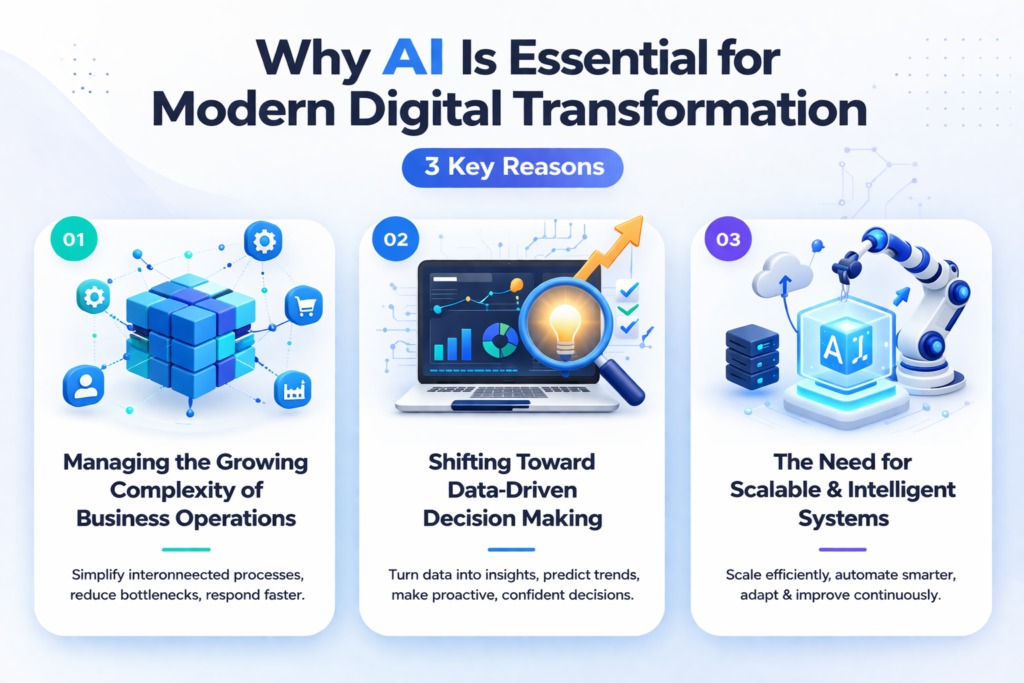
AI has become a critical component of digital transformation because today’s business environment is more complex, data-heavy, and fast-moving than ever before. Traditional systems and manual decision-making are no longer sufficient to keep up with constant changes in customer behavior, market conditions, and operational demands. AI helps organizations handle this complexity, make better decisions, and scale efficiently.
Managing the Growing Complexity of Business Operations
Modern enterprises operate across multiple channels, markets, and systems. From supply chains and customer interactions to internal workflows, everything is interconnected and constantly evolving. Managing this level of complexity manually or with static systems often leads to inefficiencies and delays.
AI helps simplify and optimize these operations by analyzing large volumes of data in real time. It can identify patterns, detect issues early, and recommend or automate actions. This allows businesses to operate more smoothly, reduce bottlenecks, and respond quickly to changes without increasing operational burden.
Shifting Toward Data-Driven Decision Making
Businesses today generate massive amounts of data, but without the right tools, much of this data remains unused. Relying on intuition or outdated reports is no longer effective in a competitive environment.
AI enables organizations to fully leverage their data by turning it into actionable insights. It supports predictive and real-time decision-making, helping leaders understand trends, anticipate risks, and identify opportunities faster. Instead of reacting to what has already happened, companies can make proactive decisions based on what is likely to happen next.
The Need for Scalable and Intelligent Systems
As businesses grow, their systems must handle increasing volumes of data, users, and processes. Traditional systems often struggle to scale efficiently and require significant resources to maintain performance.
AI-powered systems are designed to scale more effectively. They can process large amounts of data, automate complex tasks, and continuously improve without requiring constant manual updates. This makes it easier for enterprises to expand operations while maintaining efficiency and consistency.
In addition, AI adds intelligence to systems, allowing them to adapt to new conditions and optimize performance over time. This combination of scalability and adaptability is essential for sustainable growth in the digital era.
Key Advantages of AI-Enabled Digital Transformation
AI-enabled digital transformation brings measurable and strategic benefits that go beyond basic efficiency improvements. It helps enterprises operate smarter, scale faster, and stay competitive in rapidly changing markets.
Improved Operational Efficiency
One of the most immediate benefits of AI is increased efficiency. AI can automate repetitive and time-consuming tasks, reduce human errors, and streamline workflows across departments. More importantly, it can optimize processes continuously based on real-time data, helping businesses save time and reduce operational costs.
Faster and Smarter Decision-Making
AI enables organizations to move from intuition-based decisions to data-driven strategies. By analyzing large volumes of data quickly, AI provides insights that help leaders make faster and more accurate decisions. It also supports predictive capabilities, allowing businesses to anticipate trends, risks, and opportunities instead of reacting too late.
Enhanced Scalability
As businesses grow, managing increased workloads becomes more complex. AI-powered systems can handle higher volumes of data, users, and transactions without requiring proportional increases in resources. This makes it easier for enterprises to scale operations efficiently while maintaining performance and consistency.
Better Customer Experience
AI allows businesses to deliver more personalized and responsive customer experiences. By analyzing customer behavior and preferences, companies can tailor interactions, provide relevant recommendations, and respond quickly to customer needs. This leads to higher satisfaction, stronger engagement, and improved customer retention.
Continuous Learning and Optimization
Unlike traditional systems, AI systems improve over time. They learn from new data, refine their models, and adapt to changing conditions. This creates a continuous cycle of optimization, where processes become more efficient and decisions become more accurate over time.
Competitive Advantage
By combining efficiency, intelligence, and scalability, AI gives businesses a strong competitive edge. Companies that adopt AI-driven transformation can innovate faster, respond to market changes more effectively, and deliver greater value to customers compared to those relying on traditional approaches.
Core Domains Where AI Accelerates Transformation
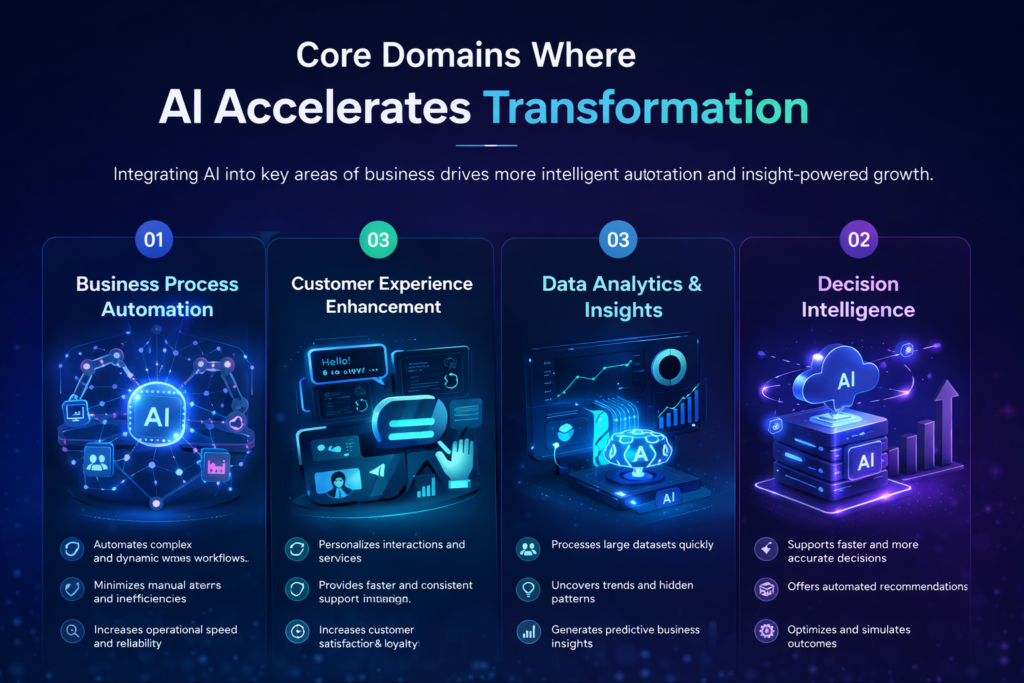
AI creates the most impact when it is embedded into key business domains rather than applied in isolation. By integrating AI across operations, customer touchpoints, and decision layers, enterprises can unlock end-to-end transformation and drive sustainable growth.
Business Process Automation
AI takes automation beyond simple rule-based tasks by enabling systems to handle more complex and dynamic workflows. It can process large volumes of data, detect patterns, and make decisions in real time, reducing the need for manual intervention.
This allows businesses to streamline operations, minimize errors, and improve overall efficiency. From finance and HR to supply chain and IT operations, AI-powered automation helps organizations run faster and more reliably while lowering operational costs.
Customer Experience Enhancement
Customer expectations are higher than ever, and AI plays a critical role in meeting those demands. By analyzing customer behavior, preferences, and interaction history, AI enables businesses to deliver more personalized and relevant experiences.
This includes tailored recommendations, faster response times through intelligent chatbots, and more consistent service across multiple channels. As a result, companies can improve customer satisfaction, increase engagement, and build stronger long-term relationships.
Data Analytics and Insights
Data is one of the most valuable assets in digital transformation, but its true value lies in how effectively it is used. AI enhances data analytics by processing large datasets quickly and uncovering patterns that are difficult to detect manually.
It transforms raw data into meaningful insights, helping businesses understand trends, monitor performance, and identify new opportunities. This allows organizations to move from descriptive analytics to predictive and even prescriptive insights.
Decision Intelligence
AI elevates decision-making by combining data analysis, predictive modeling, and automated recommendations into a unified system. Instead of relying solely on human judgment, businesses can leverage AI to support faster, more accurate, and more consistent decisions.
Decision intelligence helps organizations anticipate outcomes, evaluate different scenarios, and choose the best course of action. This is especially valuable in complex environments where speed and accuracy are critical to success.
How to Start an AI-Driven Digital Transformation Journey
Successfully adopting AI in digital transformation requires more than just technology investment. It involves a clear strategy, the right priorities, and a structured approach to scale impact across the organization.
Evaluate Your Current Digital Readiness
The first step is to understand where your business stands today. This includes assessing existing systems, data infrastructure, processes, and team capabilities. Organizations need to identify gaps in data quality, integration, and technology that may limit AI adoption.
A clear view of current digital maturity helps set realistic goals and ensures that AI initiatives are built on a solid foundation rather than disconnected experiments.
Identify High-Value AI Use Cases
Not all AI applications deliver the same level of impact. Businesses should focus on areas where AI can create the most value, such as improving efficiency, reducing costs, or enhancing customer experience.
Common high-impact use cases include intelligent automation, predictive analytics, and personalized customer engagement. Starting with targeted use cases allows organizations to demonstrate quick wins and build momentum for broader transformation.
Develop a Clear Transformation Roadmap
Once priorities are defined, the next step is to create a structured roadmap. This should outline key initiatives, timelines, required resources, and expected outcomes.
A strong roadmap aligns AI initiatives with business objectives and ensures that efforts are coordinated across departments. It also helps manage risks and track progress effectively throughout the transformation journey.
Scale AI Across the Organization
After validating initial use cases, organizations need to expand AI adoption across multiple functions. This involves integrating AI into core systems, standardizing processes, and ensuring teams are equipped to work with AI tools.
Scaling AI is not just about technology. It requires building a data-driven culture, training employees, and establishing governance to ensure consistent and responsible use of AI.
Read more: How AI Is Driving Transformation in Small Businesses
Challenges in AI-Driven Digital Transformation
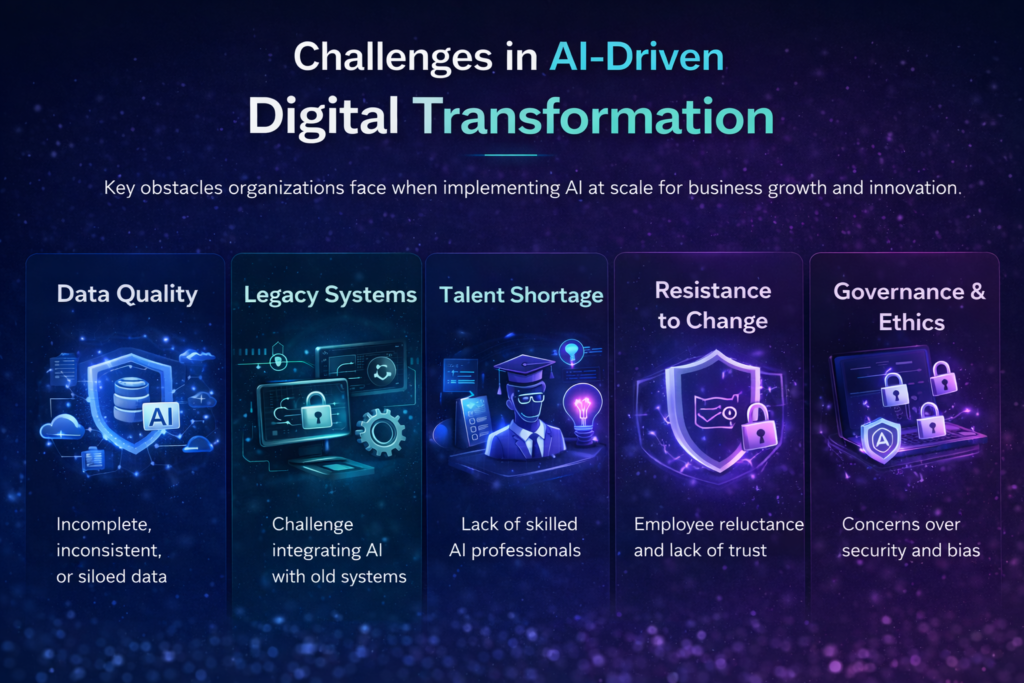
While AI brings significant benefits, implementing it at scale is not without challenges. Many organizations struggle not because of the technology itself, but due to gaps in data, systems, and organizational readiness. Focusing on the most critical challenges can help businesses prepare and mitigate risks effectively.
Data Quality and Availability
AI depends heavily on data, but many organizations face issues with incomplete, inconsistent, or siloed data. Poor data quality leads to inaccurate insights and unreliable AI outcomes.
Without a strong data foundation, even the most advanced AI models cannot deliver value. Ensuring clean, well-structured, and accessible data is one of the biggest hurdles in transformation.
Integration with Legacy Systems
Most enterprises still rely on legacy systems that were not designed to work with AI technologies. Integrating AI into these environments can be complex, time-consuming, and costly.
This challenge often slows down transformation efforts, as businesses must balance innovation with maintaining existing operations. Without proper integration, AI initiatives may remain isolated and fail to scale.
Talent and Skill Gaps
AI requires a combination of technical expertise and business understanding. However, there is a shortage of professionals who can build, deploy, and manage AI solutions effectively.
In addition, employees may lack the skills needed to work alongside AI tools. Organizations must invest in training and upskilling to ensure successful adoption and long-term sustainability.
Organizational Resistance to Change
Digital transformation with AI often requires changes in workflows, roles, and decision-making processes. This can lead to resistance from employees who are unfamiliar with or uncertain about AI technologies.
Without strong leadership and clear communication, this resistance can slow down or even block transformation initiatives. Building a culture that embraces innovation and data-driven thinking is essential.
Governance, Security, and Ethical Concerns
AI introduces new risks related to data privacy, security, and ethical use. Organizations must ensure that AI systems are transparent, fair, and compliant with regulations.
Lack of proper governance can lead to misuse of data, biased outcomes, or security vulnerabilities. Establishing clear policies and controls is critical to building trust and ensuring responsible AI adoption.
The Future of AI-Powered Digital Transformation
AI will move from a supporting role to the core engine of enterprise operations. Businesses will increasingly rely on intelligent systems that not only analyze data but also take action in real time. This shift toward automation and autonomy will allow organizations to respond faster, optimize continuously, and reduce reliance on manual processes.
At the same time, technologies like generative AI and intelligent agents will reshape how work is done. Employees will collaborate with AI to boost productivity, focusing more on strategy and creativity while AI handles execution and analysis. This will unlock new levels of efficiency and innovation across all functions.
Looking ahead, digital transformation will become fully data-driven and highly personalized. Real-time insights, adaptive systems, and tailored customer experiences will define competitive advantage. Enterprises that embed AI deeply into their strategy will be better positioned to scale, adapt, and lead in the evolving digital landscape.
Final Thoughts
AI-driven digital transformation is no longer a future concept. It is already reshaping how enterprises operate, compete, and scale. Organizations that successfully integrate AI into their core strategy can unlock greater efficiency, faster decision-making, and sustainable growth in an increasingly competitive market.
However, achieving real impact requires more than adopting new technologies. It demands a clear vision, strong data foundations, and a structured approach to implementation. Businesses need to move beyond experimentation and focus on scaling AI across the organization to create long-term value.
If your enterprise is looking to accelerate this journey, partnering with the right technology provider is critical. Solutions developed by Sphinx can help you turn AI-driven digital transformation into a practical, scalable reality, enabling your business to grow smarter, faster, and more efficiently.



CEO - Son Le
OTHER BLOGS
Blogs
AI Chatbot Applications: Benefits, Use Cases, and Future Trends
Artificial Intelligence (AI) is rapidly transforming the way businesses communicate with customers, automate workflows, and deliver personalized experiences. At the center of this transformation is the AI chatbot, an intelligent virtual assistant capable of understanding natural language, answering questions, and supporting users across websites, mobile apps, and messaging platforms. As...
Read MoreBlogs
How AI Is Revolutionizing Hotel Operations and Revenue
The hospitality industry is undergoing one of its biggest transformations in decades. As guest expectations continue to rise and operational costs increase, hotels are turning to Artificial Intelligence (AI) to stay competitive. From maximizing room revenue to delivering personalized guest experiences, AI is no longer a futuristic concept. It has...
Read MoreBlogs
AI Chatbots in Hospitality: Drive Bookings & Better Service
The hospitality industry is rapidly embracing AI as guest expectations continue to evolve. Today’s travelers expect instant responses, personalized recommendations, and seamless communication throughout their booking journey. To meet these demands while improving operational efficiency, more hotels are turning to AI chatbots. Modern AI chatbots do far more than answer...
Read MoreOTHER BLOGS
Our Sevices
IoT Development
SphinX offers cutting-edge IoT development services, seamlessly connecting devices and providing innovative solutions for a...
Xem thêmOur Sevices
Blockchain Development
We are highly proficient in engineering reliable and secure blockchain technologies from the ground up,...
Xem thêmOur Sevices
ERP & CRM Development
ERP & CRM development services that you need! Streamline business processes and enhance organizational efficiency....
Xem thêmOTHER BLOGS
Our Sevices
IoT Development
SphinX offers cutting-edge IoT development services, seamlessly connecting devices and providing innovative solutions for a...
Xem thêmOur Sevices
Blockchain Development
We are highly proficient in engineering reliable and secure blockchain technologies from the ground up,...
Xem thêmOur Sevices
ERP & CRM Development
ERP & CRM development services that you need! Streamline business processes and enhance organizational efficiency....
Xem thêm