



Artificial Intelligence has moved beyond early adoption and isolated innovation. Today, AI is embedded across enterprise operations, from data analytics and customer engagement to risk management and decision support. However, as AI usage becomes widespread, many organizations are discovering that deploying AI alone does not automatically translate into strategic advantage.
Looking ahead to 2026, AI is entering a new stage of maturity. The focus is shifting from automation and experimentation toward intelligence that can enhance human decision-making, adapt to complex business environments, and deliver insights grounded in industry context. Enterprises that recognize this evolution will be better equipped to transform AI from a technical capability into a long-term competitive asset.
In this blog, we examine the key AI trends shaping enterprise intelligence in 2026. We explore how AI is evolving to amplify human capabilities, how smarter AI infrastructure is redefining digital foundations, and why vertical, industry-specific AI is becoming essential in sectors such as healthcare and banking and finance.
AI Evolves from Automation to Human-Centered Intelligence
Early enterprise AI systems were designed to automate tasks. Their value came from executing predefined processes faster and more consistently than humans. This model worked well for stable, repetitive activities, but it treated intelligence as something that could be fully encoded into rules and algorithms.
By 2026, this assumption no longer holds. Business environments are more dynamic, decisions are increasingly interdependent, and data is more fragmented than automation-centric AI can effectively handle.

Business environments have become too dynamic, decisions too interdependent, and data too fragmented for automation-centric AI to remain effective. As a result, AI is evolving away from task execution toward human-centered intelligence, where its primary function is to support how humans understand complexity and make decisions.
In this new model, AI does not aim to replace human judgment. Instead, it acts as an analytical extension of human cognition. It continuously processes signals across systems, identifies patterns and anomalies, and organizes information in ways that align with how humans reason about problems.
The key shift lies in where intelligence is applied. Automation-focused AI operates at the process level, optimizing actions after decisions have already been made. Human-centered AI operates at the decision level, shaping how decisions are formed in the first place.
This evolution fundamentally changes the value AI delivers to enterprises. Rather than measuring success by the number of automated tasks, organizations evaluate AI by its ability to reduce uncertainty, clarify trade-offs, and improve decision quality under pressure.
By 2026, enterprises that continue to view AI primarily as an automation tool will face diminishing returns. Those that embrace human-centered intelligence will gain a decisive advantage by enabling people to make smarter, faster, and more confident decisions in increasingly complex environments.
Smarter AI Infrastructure for Scalable Enterprise Intelligence
As AI becomes embedded across enterprise operations, infrastructure determines whether intelligence can truly scale. In 2026, AI infrastructure is no longer a supporting layer. It is the backbone that enables consistent, reliable, and enterprise-wide intelligence.
Smarter AI infrastructure is defined by its ability to adapt to changing workloads, data volumes, and business priorities. Instead of static configurations, infrastructure increasingly adjusts in real time, ensuring that AI systems remain performant as demand grows. This adaptability allows organizations to expand AI usage without introducing instability or operational complexity.
At scale, intelligence must be dependable. Smarter AI infrastructure provides the stability required for AI to operate continuously in production environments, not just in isolated pilots.By standardizing data processing, deploying models consistently, and monitoring performance at scale, enterprises can move beyond experimental AI and establish operational intelligence for everyday decision-making.
Scalability is not only a technical concern but a strategic one. Infrastructure that intelligently manages resources enables organizations to balance performance and cost, avoiding the trade-off between innovation and control. This makes large-scale AI adoption sustainable rather than burdensome.
Looking ahead, industry forecasts suggest that 70% of organizations will base AI infrastructure investments on clearly defined business outcomes, including return on investment and tangible value creation. This mindset is expected to continue through 2028, as 75% of enterprise AI workloads transition to purpose-built hybrid infrastructures. These tailored environments enable organizations to accelerate value realization while effectively balancing performance demands, cost efficiency, and regulatory compliance.
By 2026, enterprises that succeed with AI will be those that treat infrastructure as a strategic investment. Smarter AI infrastructure transforms AI from a collection of tools into a scalable intelligence capability that grows with the business and strengthens long-term competitiveness.
Vertical AI: Intelligence Designed for Industry Realities
As AI adoption moves beyond generic tools, organizations increasingly require more specialized intelligence. This intelligence must understand the rules, workflows, and risk environments unique to each industry. By 2026, Vertical AI, AI systems tailored for specific sectors, becomes essential for meaningful business impact.
Vertical AI in Healthcare
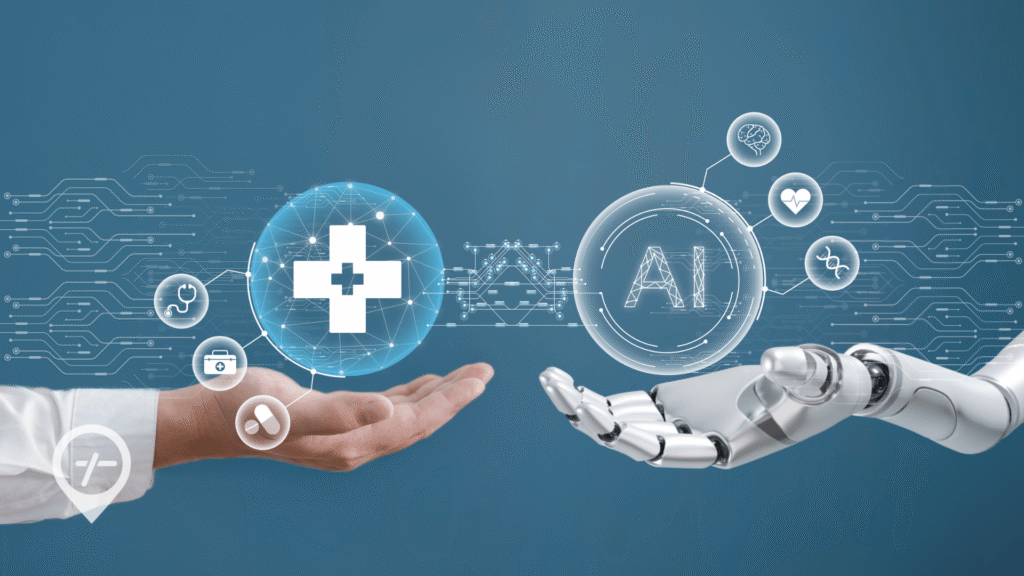
Healthcare is among the industries with the highest AI adoption rates. This trend is driven by the need to improve care delivery while reducing operational strain. Vertical AI plays a critical role by embedding clinical context and healthcare-specific workflows directly into AI systems.
Recent findings show that 49% of healthcare organizations are already experiencing tangible benefits from technology-enabled patient engagement and remote monitoring solutions. These applications allow providers to extend care beyond traditional clinical settings, improving continuity while reducing pressure on in-person services.
At the same time, AI is increasingly applied to clinical documentation and care planning, areas that traditionally consume significant staff time. By standardizing and automating these workflows, AI provides a scalable way to ease system-wide pressure while improving access and operational efficiency. According to Deloitte, 64% of health system leaders expect AI-driven standardization and automation to deliver measurable cost reductions across healthcare operations.
Together, these trends illustrate why vertical AI in healthcare is less about experimentation and more about sustainability. By aligning intelligence with clinical realities, healthcare organizations can enhance care quality, support overstretched teams, and build more resilient care models heading into 2026.
Vertical AI in Banking and Finance

Banking and finance are among the fastest-moving adopters of vertical AI, driven by the need to operate at scale while maintaining strict control over risk and compliance. As AI maturity increases, generic models are no longer sufficient. Financial institutions increasingly rely on industry-specific intelligence that understands financial behaviors, regulatory constraints, and transactional complexity.
Approximately 85% of banking and financial institutions already deploy AI in at least one core business area, signaling a decisive shift from experimentation to operational reliance. Vertical AI embeds financial domain knowledge directly into decision-making processes, enabling institutions to generate value with greater precision and accountability.
One of the most significant impacts emerges in customer engagement. AI-enabled hyper-personalization is becoming a standard capability, allowing banks to tailor interactions, products, and offers at an individual level. These AI-driven insights are delivering measurable results, including up to 92% higher digital engagement and 10–25% revenue growth from personalized offerings. These outcomes emerge only when organizations train AI systems on financial context rather than generic behavioral data.
Conversational AI in banking has also evolved well beyond traditional chatbots. Human-centered AI assistants are designed to interpret intent, tone, and context, enabling more natural and effective interactions. These systems are already capable of resolving up to 80% of customer inquiries without human intervention, with expectations that this share will exceed 90% by 2026. The result is a significant reduction in customer wait times alongside substantial savings in customer support operations.
Beyond customer-facing applications, vertical AI plays a critical role in balancing innovation with governance. By aligning AI models with financial risk frameworks and regulatory requirements, institutions can automate decisions responsibly while maintaining transparency and control. This alignment allows banks to scale AI adoption without increasing exposure or undermining trust.
Final Thoughts
The AI trends shaping 2026 signal a fundamental shift. Artificial intelligence is no longer about automating tasks in isolation, but about strengthening human decision-making, operating on intelligent infrastructure, and delivering value through industry-specific intelligence.
Enterprises that succeed will treat AI as a strategic capability, not a collection of tools. This requires aligning technology with business outcomes, building scalable foundations, and deploying AI in ways that reflect real operational and regulatory contexts.
At Sphinx, we support enterprises in translating these AI trends into practical, scalable solutions. By focusing on business impact, intelligent infrastructure, and domain-driven AI, Sphinx helps organizations move from experimentation to sustainable value creation.



CEO - Son Le
OTHER BLOGS
Blogs
AI Chatbot Applications: Benefits, Use Cases, and Future Trends
Artificial Intelligence (AI) is rapidly transforming the way businesses communicate with customers, automate workflows, and deliver personalized experiences. At the center of this transformation is the AI chatbot, an intelligent virtual assistant capable of understanding natural language, answering questions, and supporting users across websites, mobile apps, and messaging platforms. As...
Read MoreBlogs
How AI Is Revolutionizing Hotel Operations and Revenue
The hospitality industry is undergoing one of its biggest transformations in decades. As guest expectations continue to rise and operational costs increase, hotels are turning to Artificial Intelligence (AI) to stay competitive. From maximizing room revenue to delivering personalized guest experiences, AI is no longer a futuristic concept. It has...
Read MoreBlogs
AI Chatbots in Hospitality: Drive Bookings & Better Service
The hospitality industry is rapidly embracing AI as guest expectations continue to evolve. Today’s travelers expect instant responses, personalized recommendations, and seamless communication throughout their booking journey. To meet these demands while improving operational efficiency, more hotels are turning to AI chatbots. Modern AI chatbots do far more than answer...
Read MoreOTHER BLOGS
Our Sevices
IoT Development
SphinX offers cutting-edge IoT development services, seamlessly connecting devices and providing innovative solutions for a...
Xem thêmOur Sevices
Blockchain Development
We are highly proficient in engineering reliable and secure blockchain technologies from the ground up,...
Xem thêmOur Sevices
ERP & CRM Development
ERP & CRM development services that you need! Streamline business processes and enhance organizational efficiency....
Xem thêmOTHER BLOGS
Our Sevices
IoT Development
SphinX offers cutting-edge IoT development services, seamlessly connecting devices and providing innovative solutions for a...
Xem thêmOur Sevices
Blockchain Development
We are highly proficient in engineering reliable and secure blockchain technologies from the ground up,...
Xem thêmOur Sevices
ERP & CRM Development
ERP & CRM development services that you need! Streamline business processes and enhance organizational efficiency....
Xem thêm